For decades, competitive swimmers have relied on poolside clocks, wrist-worn trackers, and gut feelings to gauge their performance. But let’s be honest—craning your neck mid-stroke to catch a glimpse of the pace clock disrupts your form, and wrist devices can’t tell you what your split was on that last 100. Enter the game-changing world of heads-up display swim goggles, where real-time metrics hover in your peripheral vision like a digital coach, transforming how you train, race, and understand your pace.
These aren’t your average swim goggles with a fancy screen slapped on. We’re talking about precision-engineered wearable computers that marry optical physics with biometric sensors, all while maintaining hydrodynamic efficiency. Whether you’re chasing a personal best in the 200 IM or trying to hold consistent threshold pace through a 5K open water slog, HUD goggles deliver the data you need without breaking your stroke rhythm. But not all smart goggles are created equal, and the difference between a transformative training tool and a $300 paperweight lies in understanding the nuances of display technology, sensor accuracy, and how the data actually impacts your swimming psychology.
Top 10 Swim Goggles with Heads-Up Displays
Detailed Product Reviews
1. FORM Smart Swim 2 - Goggles

Overview:
The FORM Smart Swim 2 represents the gold standard in AR-enabled swim goggles, engineered for serious triathletes and competitive swimmers. Developed by sport scientists and Olympians, these goggles deliver real-time performance metrics directly to your field of view without disrupting your stroke rhythm. The system combines in-goggle sensors with a companion app to provide comprehensive training analytics for both pool and open-water environments.
What Makes It Stand Out:
The integrated AR display shows metrics like heart rate (97% accuracy via optical monitor), pace, distance, and stroke count in real-time. The proprietary SwimStraight compass is a game-changer for open-water navigation, while 14-hour battery life ensures multiple sessions between charges. With approvals from World Triathlon, USA Triathlon, and British Triathlon, it’s competition-ready. Five interchangeable nose bridges and industry-leading anti-fog coating demonstrate attention to detail.
Value for Money:
At $199, it’s a premium investment but justified by professional-grade accuracy and durability. Unlike competitors, core features require no subscription. The 2-year warranty and extensive app integrations (Strava, TrainingPeaks, TriDot) add long-term value. For athletes who train seriously, this replaces multiple devices and provides actionable data that translates to measurable improvement.
Strengths and Weaknesses:
Strengths include exceptional accuracy, intuitive AR interface, open-water compass, extensive third-party integrations, and race approvals. The 14-hour battery life is class-leading. Weaknesses are the high upfront cost and that advanced coaching features require a $9.99/month subscription after the first month. Some users may find the AR display initially distracting.
Bottom Line:
For dedicated swimmers and triathletes seeking data-driven improvement, the FORM Smart Swim 2 is worth every penny. The combination of accuracy, professional validation, and robust design makes it the top choice for competitive training.
2. Holoswim Smart Swim Goggles 2PRO, AR Real-Time Display, Data Tracking & Training Plans Swim Goggles with AI Data Analysis APP, No Subscription, TÜV Anti-Fog Goggle Compatible with Garmin Apple Watch

Overview:
The Holoswim 2PRO positions itself as a formidable challenger to established AR swim goggles, leveraging cutting-edge holographic waveguide technology and AI-driven analytics. Designed for elite swimmers and triathletes, it promises 99.8% tracking precision without mandatory subscription fees. The goggles aim to deliver premium features at a more accessible price point than market leaders.
What Makes It Stand Out:
The 25° field of view AR display delivers crisp 128×64 resolution metrics including pace, heart rate, and SWOLF score. Its AI Engine 2.0 with 6-axis IMU sensors automatically recognizes five strokes and rest intervals. The 3D medical-grade silicone seals and nine nose bridges ensure superior comfort, while dual sync with Garmin and Apple Watch creates a seamless training ecosystem. Wide-wing stabilizers minimize drag for competitive advantage.
Value for Money:
At $169.99, it undercuts the FORM Smart Swim 2 while offering comparable features. The absence of subscription requirements for core functionality provides significant long-term savings. For data-obsessed athletes, the 99.8% accuracy claim and AI coaching represent excellent value. The TÜV anti-fog certification and durable construction further justify the investment.
Strengths and Weaknesses:
Strengths include advanced holographic display, exceptional accuracy, comprehensive AI analysis, ergonomic design with extensive customization, and open-water compatibility. The AI-powered training adaptation is particularly impressive. Weaknesses include a less established brand reputation than FORM and unspecified battery life details. The learning curve for app features may intimidate some users.
Bottom Line:
The Holoswim 2PRO is a compelling alternative for tech-forward swimmers who prioritize precision and value. If you want premium AR capabilities without ongoing fees, this deserves serious consideration.
3. Holoswim 2S Smart Swim Goggles, Digital Real-time Data Display Smart AR Goggles with AI Data Analysis APP, No Subscription, TÜV Anti-Fog Lens, IP68 Waterproof Smart glasses for Pool & Open Water

Overview:
The Holoswim 2S democratizes AR swim technology, bringing real-time data display to a sub-$80 price point. This entry-level smart goggle targets recreational swimmers and budding triathletes who want metrics without breaking the bank, offering core tracking features without subscription barriers. It balances affordability with genuine smart functionality.
What Makes It Stand Out:
Despite the budget price, it features holographic light waveguide technology with a 25° FOV and 128×64 display. The 6-axis motion sensor achieves 99.8% accuracy in detecting 12 metrics including stroke type, SWOLF, and rest intervals. TÜV-certified anti-fog coating withstands 1,000+ scratches, while IP68 waterproofing enables both pool and open-water use. The AI Coach provides post-swim analysis and trend tracking.
Value for Money:
At $79.99, it’s arguably the best value in smart swim gear. You get genuine AR display, AI analysis, and training plans without monthly fees. For swimmers upgrading from basic goggles, this delivers 80% of premium features at 40% of the cost. The medical-grade silicone seals and four nose bridges ensure comfort without inflating price.
Strengths and Weaknesses:
Strengths include unbeatable price, accurate tracking, durable anti-fog coating, comfortable medical-grade silicone seals, and open-water mode. The no-subscription model is a major advantage. Weaknesses are fewer nose bridge options (four vs nine on 2PRO) and less advanced AI coaching features. Battery life details are not prominently specified.
Bottom Line:
For recreational swimmers ready to embrace data-driven training, the Holoswim 2S is the smart choice. It proves you don’t need to spend premium dollars to get premium tracking capabilities.
4. Holoswim Smart Swim Goggles 2GO, AR Real-Time Display Swimming Goggles with AI Stroke Recognition, Data Tracking & Training Plans, No Subscription, TÜV Anti-Fog,Smart Goggles for Pool & Open Water

Overview:
The Holoswim 2GO occupies the middle ground in the Holoswim lineup, offering AR data display and AI training features at a moderate $119.99 price. It targets intermediate swimmers seeking performance insights without the premium cost of flagship models. The goggles provide a thoughtful balance of smart features and accessibility.
What Makes It Stand Out:
The AR light waveguide lens projects real-time pace, distance, and laps with 128×64 resolution. AI stroke recognition achieves 99.8% accuracy across five strokes, while the HOLOSPORT App generates personalized training plans that auto-adjust based on performance. Nine interchangeable nose bridges and stabilizer wings ensure a secure, pressure-free fit. The TÜV anti-fog coating lasts through 1,000+ tests.
Value for Money:
This model strikes an excellent balance, offering core AR functionality and AI coaching for $50 less than the 2PRO. While lacking some premium sensors, it retains essential tracking and training features most swimmers need. The IP68 waterproof rating and durable construction ensure longevity, making it a wise investment for regular swimmers not requiring elite-level analytics.
Strengths and Weaknesses:
Strengths include accurate AR tracking, adaptive AI training plans, extensive fit customization, reliable anti-fog technology, and open-water capability. The automatic workout adjustment is particularly useful. Weaknesses include unspecified battery life and display technology that’s a step behind the 2PRO’s holographic resin. The app ecosystem is less mature than competitors.
Bottom Line:
The Holoswim 2GO is ideal for dedicated lap swimmers ready to upgrade from basic goggles. It provides meaningful performance data and coaching without the flagship price tag, making it a smart mid-range investment.
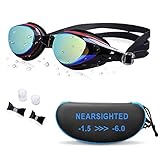
5. AIKOTOO Shortsighted Swim Goggles Anti-fog
Overview:
The AIKOTOO Shortsighted Swim Goggles strip away all technological complexity to focus on fundamental vision correction and comfort at an ultra-budget price. Designed for casual swimmers needing myopia-friendly eyewear, these goggles prioritize leak prevention and anti-fog performance over data tracking. They serve swimmers who value simplicity and affordability.
What Makes It Stand Out:
Unlike smart goggles, these feature HD mirror-coated lenses designed for nearsighted users, providing clarity without prescription costs. The environmentally friendly silicone gasket creates a flexible, leak-proof seal, while advanced anti-fog coating maintains vision clarity throughout sessions. The high-resilience strap system prevents facial marking and discomfort during extended wear.
Value for Money:
At $16.99, these represent exceptional value for swimmers who simply need reliable, comfortable goggles with vision correction. They cost 80-90% less than AR-enabled alternatives while addressing the basic requirements of casual pool use and regular training. The durable construction at this price point is impressive.
Strengths and Weaknesses:
Strengths include unbeatable affordability, effective anti-fog coating, comfortable silicone seals, leak-proof design, and myopia-specific lens options. The wide view design enhances pool awareness. Weaknesses are lack of durability compared to premium brands, no UV protection mentioned, and absence of interchangeable nose pieces for custom fit. They lack any smart features.
Bottom Line:
For recreational swimmers on a tight budget or those needing basic vision correction, the AIKOTOO goggles deliver functional performance. Don’t expect premium features, but they reliably cover the essentials for casual lap swimming and regular pool workouts.
6. FORM Smart Swim 1 - Goggles

Overview: The FORM Smart Swim 1 Goggles represent a revolutionary leap in swim technology, integrating a transparent heads-up display directly into premium swim goggles. Designed for serious triathletes and competitive swimmers, these smart goggles deliver real-time performance metrics without interrupting your stroke rhythm, transforming how athletes train and race.
What Makes It Stand Out: The standout feature is the augmented reality display showing heart rate, pace, distance, and stroke rate in real-time. The innovative SwimStraight digital compass—a world-first for open water navigation—is race-approved by major triathlon organizations. Integration with TrainingPeaks and 1,500+ structured workouts provides unprecedented in-goggle coaching capabilities.
Value for Money: At $149 plus a $9.99/month subscription, these goggles target committed athletes rather than casual swimmers. For triathletes who already invest in GPS watches and coaching, this consolidates data visibility into your natural sightline, potentially replacing multiple devices. The value proposition scales with training volume and competitive aspirations.
Strengths and Weaknesses: Strengths include cutting-edge technology, exceptional build quality with anti-fog coating, 16-hour battery life, and comprehensive app ecosystem. Weaknesses involve the ongoing subscription cost, steep learning curve for non-tech-savvy users, and being over-engineered for recreational swimmers who don’t need metric overload.
Bottom Line: These goggles are a game-changer for data-driven triathletes and competitive swimmers. If you’re serious about performance analytics and open water navigation, the investment pays dividends. Casual pool swimmers should opt for simpler, more affordable alternatives.
7. Zoomsnail Swim Goggles 2 Pack, Frameless Wide View Swimming Goggles for Adult, Anti-Fog Anti-UV No Leaking Pool Goggles for Men Women Youth

Overview: The Zoomsnail Swim Goggles 2 Pack delivers exceptional value for recreational swimmers seeking reliable eye protection without breaking the bank. These frameless goggles prioritize panoramic visibility and universal fit, making them ideal for family use, occasional lap swimming, or vacation pool time.
What Makes It Stand Out: The 180-degree wide-view lenses provide exceptional underwater visibility rarely found in budget goggles. The two-pack configuration at under $10 represents remarkable value, essentially providing backup goggles or allowing two swimmers to equip themselves simultaneously. The frameless design reduces bulk and improves comfort for extended wear.
Value for Money: At $9.99 for two pairs, these goggles cost less than a single fast-food meal. Each pair breaks down to just $5, positioning them among the most cost-effective options available. While premium features are absent, the anti-fog and UV protection match specifications of goggles costing 3-4 times more.
Strengths and Weaknesses: Strengths include unbeatable price, wide field of vision, comfortable silicone seals, and anti-fog coating. Weaknesses involve questionable long-term durability, basic strap adjustment mechanisms, and marketing materials containing confusing terminology (referencing “ski goggles”). The 30% anti-fog improvement claim lacks independent verification.
Bottom Line: Perfect for budget-conscious families, beginner swimmers, or as backup pairs in your swim bag. Don’t expect advanced features or marathon durability, but for casual use, these goggles outperform their price point dramatically. Competitive swimmers should invest in more robust single pairs.
8. View Swimming Gear Optical Swim Goggles with Case (Mixed Strengths)

Overview: The View Swimming Gear Optical Goggles address a specific but important niche: swimmers requiring prescription vision correction. These professional-grade optical goggles allow different diopter strengths for each eye, solving a common problem for those with asymmetric vision who struggle with standard goggles.
What Makes It Stand Out: The mixed-strength option is the defining feature, enabling custom configuration without the expense of fully custom-made prescription goggles. This flexibility allows swimmers to maintain clear vision underwater, crucial for technique work, lane awareness, and competitive turns. The super anti-fog treatment ensures clarity remains consistent.
Value for Money: At $42.95, these goggles sit in the mid-range price bracket but deliver specialized value unavailable in standard goggles. Compared to $200+ custom prescription options or struggling with contact lenses, they offer an economical solution for vision-impaired swimmers. The included protective case adds practical value.
Strengths and Weaknesses: Strengths include precise vision correction, UV protection, quality silicone strap, and professional anti-fog treatment. Weaknesses involve limited aesthetic options (only smoke color), potential fit issues for unusually narrow or wide faces, and the need to manually specify prescription strengths when ordering.
Bottom Line: An essential purchase for swimmers requiring different prescriptions per eye. The mixed-strength capability solves a genuine problem effectively and affordably. While not feature-rich, they excel at their core mission. Those with identical prescriptions in both eyes can find simpler alternatives.
9. AqtivAqua Swimming Goggles Swim Goggles for Adults Men Women Kids Youth Girls Boys Children DX (Clear-Lenses White/Black-Frame)

Overview: The AqtivAqua DX Swimming Goggles position themselves as a premium mid-range option, balancing advanced features with accessible pricing. Designed for regular swimmers, these goggles emphasize comfort, durability, and optical clarity through wide polycarbonate lenses and an innovative strap system.
What Makes It Stand Out: The Y-shaped split strap design provides superior stability during flip turns and vigorous swimming, preventing slippage better than traditional single straps. The one-click buckle system allows mid-swim adjustments without removal. The included ventilated protective case with drainage holes demonstrates thoughtful attention to gear longevity.
Value for Money: At $22.99, these goggles offer impressive specifications approaching premium brands at half the cost. The combination of UV400 protection, double silicone seals, polycarbonate impact resistance, and a protective case creates strong value. They bridge the gap between basic budget goggles and $40+ performance models.
Strengths and Weaknesses: Strengths include excellent comfort from double seals, 180-degree undistorted vision, durable materials, and stable Y-strap design. Weaknesses involve lesser brand recognition compared to established names, potential over-engineering for casual swimmers, and limited color options in this configuration.
Bottom Line: Ideal for regular swimmers seeking quality features without premium pricing. The strap system and comfort level make them suitable for training sessions exceeding an hour. While not revolutionary, they execute fundamentals excellently. Casual swimmers may prefer simpler options, but fitness swimmers will appreciate the upgrades.
10. Aegend Swim Goggles, Swimming Goggles No Leaking Full Protection Adult Men Women Youth

Overview: The Aegend Swim Goggles have earned popularity among recreational swimmers for delivering reliable performance at an accessible price point. These no-leak goggles focus on fundamental features—anti-fog protection, UV resistance, and comfortable sealing—without unnecessary complexity, making them a dependable choice for most adult swimmers.
What Makes It Stand Out: The quick-detachable clasp mechanism allows effortless on-and-off action without hair pulling, a common frustration with traditional goggle straps. The panoramic 180-degree view provides excellent spatial awareness, while the colorful lens coating adds style while reflecting harsh sunlight during outdoor swimming.
Value for Money: At $10.99, these goggles compete directly with budget champions while offering enhanced features like the quick-clasp system and improved nose rest. They deliver 80% of the performance of $30 goggles at one-third the price, making them an intelligent choice for cost-conscious swimmers who refuse to compromise on basic quality.
Strengths and Weaknesses: Strengths include the innovative clasp design, effective anti-fog treatment, leak-proof silicone seal, and stylish appearance. Weaknesses include potential sizing issues for smaller faces (explicitly warned against for some children) and the silicone allergy caution, which excludes a small percentage of users.
Bottom Line: A top-tier budget recommendation for adult swimmers prioritizing convenience and reliability. The quick-clasp alone justifies the minimal investment. While not built for Olympic training, they exceed expectations for lap swimming, water aerobics, and recreational use. Measure carefully if buying for youth swimmers.
The Evolution of Smart Swimming Technology
The journey from waterproof stopwatches to augmented reality swim optics represents one of the most significant leaps in aquatic sports technology. Early attempts at underwater data delivery involved clumsy wrist-worn units that required deliberate glance patterns, fundamentally altering stroke mechanics. The breakthrough came when engineers realized the solution wasn’t moving the swimmer’s eyes to the data, but moving the data to the swimmer’s eyes.
Modern HUD swim goggles leverage micro-projectors and waveguide optics to create virtual images that appear to float approximately 6-10 feet in front of you, positioned just below your natural line of sight. This placement is critical—it keeps critical metrics visible without obstructing your view of the lane ahead or forcing pupil refocus that could cause dizziness. The technology has matured from bulky prototypes with 2-hour battery life to sleek, FINA-compliant designs that integrate seamlessly into elite training routines.
What Are Heads-Up Display Swim Goggles?
At their core, HUD swim goggles are sophisticated biometric monitoring systems packaged into a hydrodynamic form factor. They combine traditional goggle functions—eye protection, watertight seal, optical clarity—with an integrated display system, motion sensors, and wireless connectivity. Unlike fitness trackers that simply log data for post-workout review, these devices provide instantaneous feedback loops that fundamentally alter the training stimulus.
The display component typically uses either OLED micro-displays or retinal projection technology, both engineered to combat underwater light refraction and the visual distortion caused by moving water. Sensors include accelerometers, gyroscopes, and magnetometers that track head position and movement patterns, while proprietary algorithms translate this raw data into meaningful metrics like split times, stroke count, distance per stroke, and SWOLF scores. The magic happens in real-time, with latency under 200 milliseconds ensuring the data you see reflects your current effort, not what you were doing three seconds ago.
How HUD Technology Works Underwater
Understanding the physics behind underwater display technology explains why some goggles feel intuitive while others induce headaches. Water’s refractive index (approximately 1.33) bends light differently than air, requiring specialized optical compensation. Premium HUD goggles employ compensated optics that account for this refraction, ensuring the virtual display appears at a consistent focal distance regardless of whether you’re above or below the surface.
The display systems use either prism-based reflection or direct retinal projection. Prism systems bounce light from a micro-display off a partially mirrored lens segment, creating a see-through overlay. Retinal projection, the more advanced approach, beams light directly onto the retina, producing brighter images with less power consumption. Both systems must combat the “wobbling” effect caused by water turbulence and head movement, employing image stabilization algorithms that would make drone camera engineers proud.
Power management presents another engineering marvel. These devices must operate in a thermally challenging environment where heat dissipation is limited by water’s high thermal conductivity and the need for waterproof sealing. Advanced models use distributed battery cells and low-power ARM processors that sip energy while maintaining computational horsepower.
Key Benefits of Real-Time Metrics
The psychological impact of immediate feedback cannot be overstated. Traditional training often involves a 5-30 second delay between effort and data verification, creating a cognitive disconnect. HUD goggles close this gap, enabling what sports scientists call “concurrent feedback training,” where you can make micro-adjustments to stroke rate, effort level, or pacing strategy in the moment.
This real-time awareness transforms pace management from a retrospective analysis into a proactive skill. You’ll develop an intuitive sense of what 1:15 pace per 100 yards actually feels like because you’re constantly calibrating effort against objective data. Over time, this creates robust pacing instincts that transfer seamlessly to race day when the goggles come off. The technology also eliminates the mental math that distracts from technique focus—no more calculating splits while trying to maintain proper catch position.
Core Features to Evaluate
When evaluating HUD swim goggles, prioritize features that align with your training goals and swimming environment. The display quality, battery endurance, sensor precision, and software ecosystem form the quadrants of a quality assessment framework.
Display Clarity and Positioning
Display resolution matters more than you might think. A fuzzy or pixelated readout forces your brain to work harder to decipher numbers, increasing cognitive load when you should be focusing on stroke mechanics. Look for specifications mentioning brightness measured in nits—a minimum of 300 nits ensures readability in bright outdoor conditions. The display’s field of view should occupy less than 10% of your visual field to avoid tunnel vision effects.
Position adjustability is crucial for comfort and safety. The virtual image should appear at a downward angle of 10-15 degrees from your natural sightline, allowing you to check metrics with a slight eye movement rather than head tilt. Some systems offer left/right eye switching or vertical adjustment to accommodate different facial structures and dominant eyes.
Battery Life Considerations
Battery specifications often list optimistic “up to” figures that rarely match real-world usage. A device claiming 16 hours might only deliver 10-12 with GPS enabled and brightness at maximum. Consider your typical training week: if you swim 90 minutes daily, you need at least 10.5 hours of active tracking plus standby time. Fast-charging capabilities become valuable for athletes training twice daily—look for models reaching 80% charge in under 45 minutes.
Battery degradation in aquatic environments presents a hidden challenge. Heat, chlorine, and saltwater accelerate lithium-ion cell aging. Premium designs feature replaceable battery modules or at least user-serviceable cells, extending the device’s useful life beyond the typical 2-3 year battery lifespan.
Sensor Accuracy and Calibration
Not all motion sensors are created equal. Consumer-grade accelerometers drift significantly during flip turns and underwater dolphin kicks, requiring sophisticated sensor fusion algorithms that combine gyroscope and magnetometer data to maintain accuracy. Ask about turn detection algorithms—does the system auto-detect pool length, or require manual input? Can it distinguish between freestyle and backstroke based on head position alone?
Calibration protocols vary widely. Some systems require a one-time pool length setup, while others demand periodic recalibration as sensor drift accumulates. The best implementations use machine learning to adapt to your personal stroke signature, improving accuracy over time. Look for devices that publish accuracy specifications: split times within ±0.1 seconds, stroke count within ±1 stroke per 50 meters.
Data Syncing and App Integration
Post-workout analysis capabilities separate toys from tools. The accompanying smartphone app should offer granular data visualization, trend analysis, and export functionality to platforms like TrainingPeaks or Strava. Bluetooth connectivity must maintain stable connections through water—no small feat given water’s RF attenuation properties. The sync process should be automatic upon exiting the pool, transferring a 90-minute workout in under 30 seconds.
Cloud backup and multi-device synchronization become important for coaches monitoring multiple athletes. API access allows integration with broader training management systems, while GDPR-compliant data handling ensures your performance data remains private and portable.
Understanding Pace Metrics and Performance Data
HUD goggles generate a wealth of metrics, but not all data points are equally valuable for pace transformation. Beyond basic split times, advanced systems calculate stroke index (distance per stroke × stroke rate), pace consistency variance, and decoupling metrics that reveal technique breakdown under fatigue.
SWOLF score—the sum of strokes and seconds taken per pool length—provides a holistic efficiency metric, but interpreting it requires context. A decreasing SWOLF at constant pace indicates improved efficiency, while increasing SWOLF suggests fatigue or form degradation. The best HUD systems color-code these metrics in real-time, turning green when you’re in your target range and red when you drift, creating an intuitive visual language that bypasses numerical processing.
Heart rate integration, either through optical sensors in the goggle seal or connectivity to chest straps, adds another dimension to pace management. Seeing your heart rate climb while pace holds steady reveals cardiovascular drift, signaling when to back off or push through. This biofeedback loop accelerates aerobic development more effectively than predetermined pace targets.
Comfort and Fit Factors
A heads-up display adds 15-30 grams to traditional goggle weight, concentrated in the lens assembly. This extra mass requires superior engineering to prevent seal leakage and facial pressure points. The distribution of weight across the nose bridge and orbital bones determines whether you’ll forget you’re wearing them or finish practice with a headache.
Seal Quality and Leak Prevention
The seal must accommodate the additional rigid components without compromising flexibility. Dual-durometer silicone seals—firmer where the electronics mount, softer against the skin—provide the best compromise. Look for seals with varied thickness profiles that conform to different face shapes. The seal’s contact surface area should be at least 8mm wide to distribute pressure evenly.
Leak testing protocols matter. Submerging and pressing should create suction that holds for 3-5 seconds without straps. If the goggles fall off immediately, the seal geometry doesn’t match your face. Some manufacturers offer fit guarantee programs with multiple nose bridge sizes included—take advantage of these to find your perfect geometry.
Strap Systems and Adjustability
Traditional silicone straps stretch and degrade with chlorine exposure, causing the goggles to loosen mid-workout. Modern HUD goggles employ braided polymer cords with micro-adjustment buckles that maintain tension without elastic fatigue. Split-strap designs distribute the 150-200 grams of strap tension across a wider area of the occipital bone, reducing pressure points.
Quick-release mechanisms become valuable for triathletes or open water swimmers who need rapid transitions. The buckle system should allow single-handed adjustment while treading water, with tactile clicks that confirm engagement without visual verification.
Lens Technology and Optical Options
The lens serves dual masters: protecting the display electronics while providing optical clarity. Polycarbonate dominates due to impact resistance, but premium models use treated glass for superior scratch resistance and optical purity. The lens curvature must balance hydrodynamics with minimal distortion—every diopter of lens power error induces eye strain during long sessions.
Anti-Fog Coatings and Hydrodynamics
Standard anti-fog coatings last 4-6 weeks before degrading. HUD goggles require more durable solutions since fogging renders the expensive display useless. Hydrophilic nano-coatings that bond at the molecular level maintain clarity for 3-6 months with proper care. Some systems integrate active defogging using minute heating elements powered by the main battery—overkill for most, but invaluable for open water swimmers in cold conditions.
The lens profile affects drag more than you might expect. A lens that protrudes 2mm beyond the orbital ridge adds measurable resistance over 1000 yards. Hydrodynamic models feature lens profiles that sit flush with the forehead and cheekbones, with transition zones angled to guide water flow around rather than against the goggle body.
UV Protection and Tint Variations
For outdoor swimmers, UV400 protection is non-negotiable. The display brightness must auto-adjust based on ambient light—too dim in bright sun, too bright in indoor pools. Photochromic lenses that transition from clear to dark in 30-45 seconds offer versatility, though they add cost and slightly reduce display brightness in all conditions.
Mirror coatings serve both style and function, reflecting infrared heat that can cause lens warping in hot climates. However, mirrored surfaces can interfere with optical sensors used for heart rate monitoring, requiring careful placement of sensor windows.
Durability and Build Quality
A $300+ investment demands longevity. The weakest points are always the seals around buttons, charging ports, and the display module. Look for devices with IPX8 ratings tested to at least 3 meters depth, though surface swimming rarely exceeds 1 meter. The rating should specify duration—30 minutes continuous submersion indicates robust sealing.
Stress testing data reveals much about real-world durability. Quality manufacturers publish results from chlorine immersion tests (500+ hours), saltwater corrosion resistance, and UV aging simulations. The strap attachment points should be reinforced with metal bushings rather than plastic-on-plastic connections that fatigue and crack.
Water Resistance Ratings Explained
IP ratings tell only part of the story. IPX8 means protection against continuous immersion, but doesn’t specify chemical resistance. Chlorine and saltwater attack seals differently than fresh water. Premium HUD goggles undergo ASTM F2458 testing for chemical permeation resistance, ensuring gaskets and adhesives won’t swell or degrade.
Pressure cycling tests simulate the repeated pressure changes during flip turns and dives. Each turn subjects the goggle interior to a brief pressure spike as water forces its way around the seal. Quality designs incorporate micro-venting systems that equalize pressure without allowing water ingress—think of it as a one-way valve for air.
Software Ecosystem and Compatibility
The hardware is only as good as the software interpreting its data. Evaluate the ecosystem holistically: does the manufacturer regularly update firmware? Are new features added or just bug fixes? Community forums and developer API access indicate a healthy, evolving platform.
Compatibility with existing training tools matters. Can the goggles receive pace alerts from your coach’s workout app? Do they integrate with pool timing systems for automatic split recording? The best platforms support ANT+ and Bluetooth 5.0 simultaneously, connecting to heart rate monitors, footpods (for dryland), and even smart pool platforms that adjust pace lights based on your real-time performance.
Training Plans and Coaching Integration
Advanced HUD systems move beyond passive data display to active coaching. Adaptive training plans adjust daily workouts based on your accumulated fatigue scores, sleep data, and performance trends. The goggles display target paces that automatically scale as your fitness improves, eliminating the guesswork from periodization.
Coach-sharing features allow your trainer to push workouts directly to your goggles, complete with pace parameters and rest intervals. During the set, the display shows real-time compliance—green when you’re on target, amber when you’re close, red when you’ve missed the mark. Post-workout, your coach receives detailed stroke analysis without you having to remember what lap 17 felt like.
Price vs. Value Analysis
The HUD goggle market spans $150 to $400+, but price doesn’t always correlate with value for your specific needs. Budget-conscious swimmers should prioritize core functionality: accurate splits, reliable display, and basic app integration. Premium features like open water GPS, advanced biomechanics analysis, and AI coaching deliver value proportional to how seriously you train.
Consider cost-per-use. A $300 goggle used 5x weekly for two years costs approximately $0.58 per workout. Compare this to ongoing coaching fees or pool membership costs, and the investment often justifies itself through improved training efficiency. However, if you swim recreationally twice weekly, that cost-per-use jumps to $2.88, making a mid-range option more sensible.
Common Mistakes to Avoid When Buying
First-time buyers often overemphasize feature quantity over quality. A goggle promising 27 metrics but delivering them with 5% error rates provides less value than one delivering 5 metrics at 0.5% accuracy. Focus on the data points that directly impact your pacing: split times, stroke rate, and distance.
Another pitfall is ignoring compatibility with your existing tech stack. Buying goggles that don’t sync with your preferred training platform creates data silos, forcing manual export/import routines that you’ll abandon within weeks. Always verify integration before purchasing.
Fit testing is frequently overlooked when buying online. Many retailers offer 30-day return policies specifically for this reason—use them. Swim with the goggles for at least three sessions before deciding, as pressure points often don’t manifest until the seal compresses after initial use.
Making the Final Decision: Your Swimming Profile
Match the goggle capabilities to your swimming identity. Sprint specialists need rapid split updates every 25 yards and stroke rate precision to the tenth of a stroke. Distance swimmers prioritize battery life and comfort over 90-minute sessions. Triathletes require open water GPS and seamless transitions between pool and lake.
Age-group swimmers should seek durability and simplicity—complex menus frustrate young athletes and coaches alike. Masters swimmers often value large, high-contrast displays that accommodate aging eyes. Consider your primary training environment: indoor pool swimmers can sacrifice display brightness for battery life, while outdoor specialists need maximum nits and UV protection.
Frequently Asked Questions
1. How accurate are the pace metrics compared to a poolside pace clock?
Quality HUD goggles achieve split accuracy within ±0.1 seconds of official touchpad systems when properly calibrated. The key is turn detection algorithm sophistication—premium models use multi-sensor fusion to detect wall contact with 99% reliability, while budget options may miss 5-10% of turns, requiring manual correction.
2. Will wearing HUD goggles affect my stroke technique or head position?
During the first 2-3 sessions, most swimmers experience a 1-2 degree head lift when checking metrics. However, studies show this adaptation disappears by session 5 as the display position becomes subconscious. The low placement (10-15° below sightline) minimizes disruption compared to checking a wrist device, which requires 20-30° arm rotation.
3. Can I wear prescription lenses with HUD swim goggles?
Several manufacturers offer prescription inserts that mount behind the main lens, correcting vision while keeping the HUD optics intact. Alternatively, some models allow custom lens ordering with your prescription ground directly into the polycarbonate. Expect to pay $80-150 extra and wait 2-4 weeks for custom fabrication.
4. How do these goggles handle open water swimming without pool walls for calibration?
Open water mode uses GPS for distance and pace, with accuracy depending on satellite signal quality. In ideal conditions, GPS drift is ±2-3 meters; in poor conditions with tree cover or tall buildings, this can increase to ±10 meters. Advanced models supplement GPS with accelerometer dead reckoning during signal drops, maintaining pace continuity.
5. What’s the typical lifespan of a pair of HUD swim goggles?
With proper care—rinsing after use, storing in a cool dry place, avoiding direct sunlight—the electronic components last 3-4 years. The seal typically degrades first, requiring replacement every 12-18 months depending on chlorine exposure. Many manufacturers sell seal replacement kits for $20-30, extending total lifespan to 5+ years.
6. Are HUD goggles legal for competitive swimming?
Currently, FINA bans “wearable technology” in sanctioned competition, explicitly prohibiting HUD goggles in pool events. However, they remain legal for training and most masters meets. Open water swimming has more lenient rules, with some events allowing data displays. Always check specific meet regulations—some triathlon organizers permit them in non-drafting categories.
7. How do I prevent the display from fogging up during long sets?
Beyond standard anti-fog sprays, ensure you’re not overtightening the straps, which compresses the seal and reduces airflow. Some athletes apply a thin layer of baby shampoo to the interior lens weekly, creating a surfactant layer that disperses condensation. Active defogging models with heating elements maintain clarity automatically but reduce battery life by 15-20%.
8. Can coaches monitor my real-time data during practice?
Yes, but this requires the goggle’s app to support “coach mode” with live data streaming via Bluetooth to a tablet on deck. Range is limited to 30-50 feet depending on pool interference. The data updates every 2-5 seconds, showing splits, stroke rate, and heart rate for multiple swimmers simultaneously. This feature is typically limited to premium team-focused models.
9. What’s the learning curve for interpreting data while swimming?
Most users achieve basic competency within 3-5 sessions, reading split times and stroke count automatically. Mastering advanced metrics like SWOLF efficiency and pace consistency takes 2-3 weeks. The key is starting with one metric per workout, gradually adding complexity as each data point becomes background information rather than a focal point.
10. Do these goggles work for all four competitive strokes?
Quality HUD goggles automatically detect stroke type based on head movement patterns and acceleration signatures. However, accuracy varies: freestyle and backstroke detection exceeds 98%, while butterfly and breaststroke classification hovers around 90-95% due to similar head bobbing patterns. You can manually override stroke selection in the app post-workout to correct misclassifications.