The muddy trek across a rain-soaked soccer field with armloads of practice cones and deflated balls is a ritual every team manager knows too well. Add a few helmets, shoulder pads, or basketballs to that load, and suddenly you’re juggling more than just equipment—you’re managing chaos. This is where team sports gear organizer carts with all-terrain wheels shift from luxury to absolute necessity. These mobile command centers don’t just transport gear; they transform how teams operate, turning frantic pre-game scrambles into streamlined efficiency.
Whether you’re coaching a youth league that practices on uneven park fields or managing equipment for a high school football program navigating stadium stairs and gravel paths, the right cart becomes an extension of your team. But not all “all-terrain” claims are created equal, and the difference between a $200 disappointment and an $800 decade-long investment lies in understanding the engineering, materials, and design features that actually matter when you’re pushing 200 pounds of gear through challenging conditions.
Top 10 Team Sports Gear Organizer Carts with All-Terrain Wheels
Detailed Product Reviews
1. Champion Sports High-Impact All-Terrain Cart - 53" L x 19" W x 59" H - White

Overview: The Champion Sports High-Impact All-Terrain Cart is a heavy-duty storage solution designed for institutional environments like schools, gyms, and athletic facilities. Measuring an impressive 53" x 19" x 59", this cart offers substantial capacity for balls, equipment, and gear. Its all-terrain design features non-marring wheels and heavy-duty swivel casters that smoothly transition between indoor floors and outdoor surfaces without causing damage.
What Makes It Stand Out: This cart distinguishes itself with genuine all-terrain capability and thoughtful engineering. The foldaway molded handles collapse flat for compact storage—a rare feature in carts this size. The heavy-duty swivel casters provide exceptional stability when fully loaded, while the non-marring wheels protect expensive gym flooring. Unlike consumer-grade organizers, this unit is built to withstand daily institutional abuse and weather exposure.
Value for Money: At $369.10, this represents a premium investment, but the price is justified for its target market. Cheaper alternatives typically fail within a year under heavy use, while this cart’s robust construction ensures longevity. For schools or recreation centers requiring reliable daily transport, the cost-per-year of ownership makes it economical compared to replacing inferior carts repeatedly.
Strengths and Weaknesses: Strengths include exceptional durability, true all-terrain mobility, floor protection, high capacity, and space-saving foldaway handles. Weaknesses are its substantial price point, large footprint that may overwhelm home garages, and potential overkill for casual users. The cart arrives without equipment, which is standard but worth noting.
Bottom Line: Ideal for institutions needing reliable, heavy-duty transport. Overkill and overpriced for typical home use, but unbeatable for schools, gyms, or facilities requiring daily, rugged performance.
2. EXTCCT Ball Storage Sports Equipment Organizer - Garage Storage Cart Rolling Ball Storage Rack with Hooks Wheels Outdoor Indoor Gym Gear Toy Holder Bin for Basketball, Baseball, Soccer

Overview: The EXTCCT Ball Storage Organizer is a budget-friendly solution for taming garage and home sports equipment chaos. Priced at $79.89, this versatile rack features multiple tiers designed to hold up to six basketballs on its middle layer while providing additional shelves for helmets, gloves, bats, and other gear. Its compact design suits both indoor and outdoor environments.
What Makes It Stand Out: This organizer shines with customer-centric features: pre-installed screws prevent part loss and simplify assembly to about 20 minutes, while a comprehensive assembly video guides users through the process. The standout is the generous 2-year warranty and responsive customer service, offering replacement parts promptly—uncommon in this price range.
Value for Money: At under $80, this represents exceptional value. Comparable steel organizers cost 30-50% more, and the included warranty provides peace of mind typically reserved for premium products. For home users needing basic organization without institutional-grade durability, it’s a cost-effective choice that doesn’t sacrifice functionality.
Strengths and Weaknesses: Strengths include affordability, easy assembly with pre-installed hardware, versatile storage options, indoor/outdoor versatility, and outstanding warranty coverage. Weaknesses are limited ball capacity (only six basketballs), unspecified material durability compared to steel alternatives, and potential stability issues when heavily loaded. The plastic components may not withstand harsh weather long-term.
Bottom Line: An excellent entry-level organizer perfect for families and casual athletes. The warranty and ease of assembly make it a low-risk purchase, though heavy users should consider more robust options.
3. GarveeLife Sports Equipment Organizer, Large Capacity Garage Sports Toy Organizer with Hooks and Baskets, Rolling Ball Cart with Wheels for Toy and Gear Organizer, Black
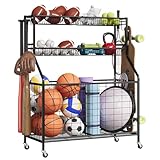
Overview: The GarveeLife Sports Equipment Organizer is a steel-constructed storage rack offering a balance of durability and versatility for home and garage organization. Measuring 36.1" wide and 45.6" tall, this black powder-coated unit features two large baskets, two metal shelves, and multiple removable hooks to accommodate balls, bats, helmets, and various sports gear.
What Makes It Stand Out: This organizer’s primary advantage is its robust steel construction with a scratch and rust-resistant powder coating, ensuring longevity in both indoor and outdoor environments. The upgraded precision wheels with locking mechanisms provide secure mobility, while the thoughtful inclusion of multiple hook types offers customizable storage configurations that adapt to different equipment collections.
Value for Money: Priced at $82.99, this sits in the sweet spot between flimsy budget racks and overbuilt institutional carts. The steel frame justifies the slight premium over plastic alternatives, offering better durability and load-bearing capacity. For homeowners seeking a permanent solution rather than a temporary fix, this represents solid long-term value.
Strengths and Weaknesses: Strengths include durable steel construction, rust-resistant coating, locking wheels for stability, versatile basket and hook configuration, and suitability for multiple environments. Weaknesses include a more complex assembly process than advertised, potential for rust if the powder coating chips, and wheels that may struggle on rough outdoor terrain despite claims. The capacity is moderate compared to larger institutional units.
Bottom Line: A sturdy, reliable choice for homeowners wanting steel durability without institutional pricing. Perfect for garages and basements where moderate capacity and lasting construction are priorities.
4. DWVO Sports Equipment Organizer, 3 Golf Bags Storage Stand with Wheels, Sport Gear Accessories Rack and Ball Organizer Bin for Garage
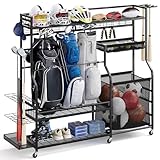
Overview: The DWVO Sports Equipment Organizer is a specialized storage solution catering primarily to golf enthusiasts while accommodating general sports gear. At $109.99, this rack features a dedicated middle shelf for up to three golf bags, side shelves for clubs, two mesh ball bags, an upper tray for accessories, and eight hooks for hats and smaller items.
What Makes It Stand Out: This organizer’s golf-specific design is its defining feature, with elastic straps that secure bags during movement—a detail rarely seen in multi-purpose racks. The six-wheel system (two with brakes) provides exceptional mobility and stability. The efficient partitioning ensures every item has a designated spot, eliminating the cluttered look of generic storage systems.
Value for Money: While pricier than basic organizers, the $109.99 tag is justified for golfers needing dedicated bag storage. Similar golf-specific racks often exceed $150, making this a mid-range bargain. For non-golfers, the value diminishes as you’re paying for specialized features you won’t use, though it remains functional for general gear.
Strengths and Weaknesses: Strengths include golf-optimized design, superior six-wheel mobility with brakes, secure elastic straps, thoughtful compartmentalization, and robust steel construction. Weaknesses are its niche focus that may not suit all users, mesh bags that could tear over time, and a footprint that consumes significant garage space. The assembly instructions could be clearer for the wheel system.
Bottom Line: A must-have for serious golfers seeking organized bag storage. For general sports gear, it’s capable but not optimal—consider only if golf equipment dominates your collection.
5. Champion Sports Equipment Cart White

Overview: The Champion Sports Equipment Cart is a large-capacity storage solution designed for institutional settings where massive equipment volumes require regular transport. This $299.99 cart features a lightweight plastic frame that can hold up to 32 basketballs, 40 soccer balls, 150 jump ropes, or 48 hoops, making it ideal for schools, recreation centers, and gyms with extensive gear collections.
What Makes It Stand Out: This cart’s staggering capacity in a relatively lightweight package sets it apart. The durable plastic construction resists moisture and corrosion while protecting indoor floors with non-marring wheels. As a product from Champion Sports—a trusted institutional brand—it delivers reliable performance for daily professional use where moving large quantities efficiently is paramount.
Value for Money: At $299.99, it’s a significant but worthwhile investment for institutions. While cheaper than the all-terrain model, it still commands a premium over consumer-grade options. However, the capacity-per-dollar ratio is excellent for organizations that would otherwise need multiple smaller carts. For home use, it’s overkill both in capacity and cost.
Strengths and Weaknesses: Strengths include massive storage capacity, lightweight plastic construction, floor-protecting wheels, trusted brand reputation, and easy assembly. Weaknesses are the plastic frame’s potential to crack under extreme weight, lack of foldaway handles for storage, large footprint requiring dedicated space, and price point prohibitive for home users. It’s not designed for outdoor terrain despite institutional build.
Bottom Line: Perfect for schools and facilities needing to move huge equipment quantities daily. Impractical for home use—families should opt for smaller, more affordable organizers.
6. Sports Ball Storage Cart - Garage Equipment Basketball Rack Organizer with 4 Lockable Wheels & Flip-Top Lid, Rolling Exercise Ball Holder for Gym, School, Club, Playgroup, Indoor & Outdoor

Overview: The Sports Ball Storage Cart offers an affordable solution for organizing athletic equipment. Constructed from steel tubing and wire mesh with an anti-rust coating, this versatile organizer handles daily use in various settings. Its compact vertical design makes it ideal for homes, schools, gyms, and clubs where space is at a premium.
What Makes It Stand Out: The innovative center-mounted hinge design on the dual top doors prevents the common failure point of side-mounted hinges. Both doors open separately and are completely removable when needed. Four lockable swivel wheels provide 360-degree mobility and secure positioning on any surface, from smooth gym floors to uneven outdoor terrain.
Value for Money: At $39.99, this cart delivers exceptional value. Comparable organizers typically start at $60+, making this an accessible option for budget-conscious buyers. The durable steel construction and smart engineering features typically found on premium models make it a wise investment for casual to moderate use.
Strengths and Weaknesses: Strengths include the innovative hinge design, smooth mobility with locking wheels, versatile ball compatibility, and rust-resistant coating. The raised handle enhances ergonomics. Weaknesses include limited capacity for large collections and the manufacturer’s note that it’s not suitable for long-term outdoor storage, requiring indoor sheltering.
Bottom Line: This storage cart is an excellent choice for families, small gyms, or schools needing affordable, mobile ball organization. The smart hinge design and lockable wheels add unexpected premium features to a budget-friendly package.
7. Wagons Carts Foldable,360lbs Collapsible Wagon Foldable Wagon with Wheels, Portable Folding Cart for Camping, Picnic,Beach, Groceries,Outdoor Sports,Shopping (Black)
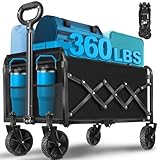
Overview: This foldable wagon cart redefines portable hauling with its impressive 360-pound capacity and ultra-compact design. Weighing only 11 pounds yet constructed from high-strength alloy steel and 600D Oxford fabric, it tackles everything from camping gear to sports equipment. The water-resistant and scratch-resistant build ensures durability across various outdoor activities.
What Makes It Stand Out: The wagon’s ability to save 80% of space when folded sets it apart from bulkier alternatives. Assembly requires simply snapping on four wheels and attaching the handle, collapsing flat in seconds by lifting a bottom strap. All-terrain wheels handle grass, sand, and pavement with equal ease, while adjustable handle height and integrated cup holders add thoughtful convenience.
Value for Money: Priced at just $35.99, this wagon delivers remarkable value. Competitors with similar weight capacities often exceed $80, making this an economical choice for families, coaches, and outdoor enthusiasts. The combination of premium materials and user-friendly features at this price point is genuinely impressive.
Strengths and Weaknesses: Strengths include exceptional weight-to-capacity ratio, effortless folding mechanism, all-terrain mobility, and versatile applications from beach trips to grocery runs. The adjustable handle enhances user comfort. Weaknesses involve the fabric’s potential wear over time with heavy loads, and it’s not specifically designed for ball storage, lacking containment features.
Bottom Line: This is a must-have multi-purpose hauler for anyone needing portable, high-capacity transport. Its unbeatable price and space-saving design make it perfect for families and outdoor adventurers.
8. VEVOR Sports Equipment Garage Organizer Steel, Rolling Ball Storage Cart on Wheels, Basketball Rack with Baskets & Hooks, Indoor/Outdoor Sports Gear and Toys Storage Christmas Crafts Xmas Gift

Overview: The VEVOR Sports Equipment Organizer is a comprehensive storage solution for serious athletes and families with diverse sporting gear. This heavy-duty steel unit combines multiple storage components—a wire basket, elastic band box, double rod, and side rack holding up to 12 clubs—into one mobile system. The powder-coated finish resists rust and scratches for indoor/outdoor versatility.
What Makes It Stand Out: Unlike simple ball carts, this organizer’s diverse configuration allows categorized storage of balls, rackets, clubs, helmets, and accessories using four removable hooks. The elastic band system maximizes ball box capacity while providing easy bottom access. The side club rack is a standout feature rarely found in this category, making it ideal for golf or hockey families.
Value for Money: At $70.99, this organizer sits in the sweet spot between budget carts and premium systems. Considering its multi-functionality and heavy-duty construction, it offers excellent value for households needing more than just ball storage. Comparable specialized organizers often exceed $100.
Strengths and Weaknesses: Strengths include versatile storage options, sturdy steel construction, lockable wheels, and capacity for various equipment types. The scratch-resistant textured paint enhances durability. Weaknesses include potentially complex assembly with multiple components and its larger footprint, which may overwhelm smaller spaces. The design might be excessive for those needing only ball storage.
Bottom Line: This is the ideal solution for multi-sport families or garage organization enthusiasts. Its versatility and durable build justify the moderate investment for comprehensive equipment management.
9. Mythinglogic Rolling Ball Storage Cart, Sports Equipment Storage Organizer for Garage/Basement/Entryway, Ball Storage Bin with Casters (Extra Large)

Overview: The Mythinglogic Rolling Ball Storage Cart positions itself as a premium, heavy-duty solution for serious ball storage needs. With capacity for up to 11 basketballs or mixed sports equipment, its all-steel construction and lockable hinged cover provide security and durability. The 35.4" x 25.9" x 24" dimensions offer substantial storage while maintaining mobility.
What Makes It Stand Out: This cart’s lockable hinged cover is a premium feature that keeps equipment secure and protected, distinguishing it from open-top competitors. The heavy-duty rubber wheels ensure smooth transport across various surfaces, while the fully folding design allows for compact storage when not in use. Quick 15-minute assembly is impressive for such a robust unit.
Value for Money: At $169.99, this is a significant investment. However, the commercial-grade construction, security features, and extra-large capacity justify the premium pricing for those needing serious storage. Budget options cost significantly less but lack the durability and security features.
Strengths and Weaknesses: Strengths include massive capacity, lockable cover for security, heavy-duty rubber wheels, robust all-steel construction, and quick assembly. The folding design adds storage flexibility. Weaknesses center on the high price point and large footprint, which may be excessive for casual users or smaller homes. The weight when fully loaded could challenge some users.
Bottom Line: This premium cart is worth the investment for schools, gyms, or large families with extensive sports equipment collections. The security and durability features make it a long-term solution.
10. Sports Ball Cart with Wheels - Holds 300 Baseballs or 150 Softballs, Equipment Storage for Caddy Large Capacity - Durable Steel Frame & Anti-Puncture Tires for Gym School Club Indoor Outdoor Training

Overview: Specifically engineered for baseball and softball programs, this specialized cart holds an impressive 300 baseballs or 150 softballs in its 17.7" x 17.7" x 25.6" steel frame. The 50-inch ergonomic height eliminates back strain during practice, while heavy-duty powder coating ensures durability in harsh field conditions. This is professional-grade equipment for serious training environments.
What Makes It Stand Out: The oversized 10.5-inch all-terrain tires conquer grass, dirt, turf, and gym floors effortlessly, providing unmatched mobility. The open basket design allows coaches quick ball access without slowing practice tempo. Assembly is streamlined with included tools, clear instructions, and even a video guide, making setup genuinely effortless.
Value for Money: At $129.99, this cart offers solid value for teams and training facilities. While pricey for individual use, its specialized capacity and professional features justify the cost for coaches and organizations. Comparable team equipment often exceeds $150, making this a reasonable investment for its target market.
Strengths and Weaknesses: Strengths include massive ball capacity, ergonomic height reducing physical strain, excellent all-terrain mobility, durable rust-resistant steel, and quick assembly. The open design facilitates easy access. Weaknesses include its single-purpose nature unsuitable for varied equipment, large footprint requiring storage space, and premium price point unnecessary for casual players.
Bottom Line: This is an essential tool for baseball/softball teams, coaches, and training facilities. Its specialized design and ergonomic features make it a worthwhile investment for organized practice efficiency.
Why All-Terrain Wheels Transform Team Sports Management
Standard utility carts collapse under the demands of athletic environments. Those tiny plastic wheels that work fine on smooth garage floors will bury themselves in soft turf, sink into sand-filled beach volleyball courts, or shatter on rocky baseball field access roads. All-terrain wheels fundamentally change the physics of gear transport by distributing weight across larger surface areas and employing tread patterns that grip rather than glide.
The real magic happens in the axle clearance and wheel diameter. A true all-terrain cart for sports applications needs minimum 10-inch wheels, with 12-14 inches being optimal for navigating curbs, tree roots, and the unpredictable terrain between parking lots and playing fields. The axle height determines whether you’ll be dragging the frame through mud or floating above it, protecting both your gear and the cart’s structural integrity.
Decoding Weight Capacity: From Youth Leagues to Pro Teams
Weight ratings on gear carts often tell only half the story. A manufacturer might advertise a 300-pound capacity, but that number typically refers to static load—gear sitting stationary. Dynamic load, the weight the cart handles while moving over uneven terrain, can be 20-30% less due to stress concentration on individual wheels during impact.
For youth soccer teams with 15 players, you’re realistically moving 150-180 pounds of balls, pinnies, cones, and first-aid kits. High school football programs easily exceed 400 pounds when transporting helmets, shoulder pads, and tackling dummies. Always calculate your maximum load, then add a 25% safety margin. This buffer accounts for unexpected additions, the weight of a rain-soaked canopy, and the cumulative stress of daily use that gradually fatigues frame welds over time.
Frame Material Science: What Your Cart Is Really Made Of
The skeleton of your gear cart determines its lifespan more than any other factor. Each material brings distinct advantages and compromises that directly impact performance in athletic environments.
Steel Frames: The Heavyweight Contenders
Powder-coated steel offers unmatched raw strength and affordability. A well-constructed steel frame can handle decade-long abuse from daily loading and rough terrain. However, the moment that powder coating chips—and it will—moisture begins its inevitable assault. Rust doesn’t just look bad; it expands, weakening joints and eventually causing catastrophic failure at weld points. Steel carts weigh 30-40% more than aluminum alternatives, making them harder to lift into storage or vehicle beds.
Aluminum Alloys: Lightweight Champions
Aircraft-grade aluminum (6061-T6) provides the sweet spot for most programs. At one-third the weight of steel, these carts reduce user fatigue significantly. The natural oxidation layer prevents corrosion without relying on coatings that can scratch. The trade-off? Lower impact resistance. A hard collision with a concrete curb can bend aluminum tubing, though quality carts use thicker wall diameters to compensate. Aluminum carts typically cost 40-50% more than steel but save that money in reduced maintenance and longer functional life.
Composite Materials: The Modern Alternative
High-density polyethylene (HDPE) frames with internal aluminum reinforcement represent the cutting edge. These carts laugh off moisture, never rust, and absorb impacts that would dent metal frames. They’re ideal for salt-air coastal environments or programs that store equipment outdoors. The downside? Limited repairability. A cracked composite joint often means replacing the entire frame section, and these carts command premium prices—sometimes double the cost of steel alternatives.
Wheel Engineering: Beyond the “All-Terrain” Label
Marketing departments love to slap “all-terrain” on anything with slightly larger wheels. True all-terrain performance requires specific engineering decisions that serious buyers must understand.
Tire Types: Pneumatic vs. Solid vs. Hybrid
Pneumatic (air-filled) tires provide superior shock absorption, protecting fragile equipment and reducing vibration stress on the frame. They excel on gravel and grass but require maintenance—checking pressure weekly and dealing with flats from thorns or sharp debris. Solid rubber tires eliminate flat worries but transmit every bump directly to your gear and arms. The hybrid solution—solid core with foam cushioning—offers 80% of pneumatic comfort with zero maintenance, making it increasingly popular for institutional purchases.
Axle Strength and Bearing Quality
A cart is only as strong as its axle assembly. Look for 5/8-inch minimum axle diameter with hardened steel construction. Bearings should be sealed ball bearings, not cheap sleeve bushings. Quality bearings allow the cart to glide with 30 pounds of force rather than 60, a difference your shoulders will appreciate during the third trip of the day. Quick-release axle pins enable wheel removal for storage or replacement without tools—a feature that proves invaluable when a bearing fails mid-season.
Sport-Specific Storage Configurations
Generic storage bins waste space and create gear damage. The best carts offer configurations tailored to your sport’s unique equipment profile.
Soccer: Managing Balls, Cones, and Kits
Soccer gear carts need vertical ball storage—cylindrical tubes or tall bins that prevent ball avalanche when you open the lid. A 32-ball capacity cart should include dividers to separate match balls from practice balls. Cone storage requires a dedicated tray or hanging system; throwing them in the main compartment creates a tangled mess that wastes 40% of your space. Look for a separate ventilated compartment for sweaty pinnies to prevent mildew during transport.
Football Equipment Challenges
Football gear carts must accommodate helmet racks that prevent facemask bending. Padded shelves for shoulder pads protect straps and hardware from snagging. The sheer bulk demands wider wheel spacing—carts under 24 inches between wheels become tippy when loaded with 12 helmets and corresponding pads. A dedicated vertical tube for holding kicking tees and flag belts keeps small items accessible. The best designs include a lockable compartment for expensive communication headsets and medical supplies.
Baseball/Softball: Bats, Gloves, and Specialized Equipment
Baseball gear carts need segmented bat storage preventing metal-on-metal contact that damages expensive composite bats. Glove shelves should be perforated for ventilation—leather trapped in airtight spaces grows mold in humid climates. Look for a separate compartment with a hard liner for baseballs/softballs; the weight concentrates at the bottom and can tear fabric liners over time. Many coaches appreciate a fold-out table surface for scorebooks and lineup cards during games.
Court Sports: Basketball and Volleyball Essentials
Indoor court sports require non-marking wheels that won’t scuff gym floors. The cart should be narrow enough (under 30 inches) to fit through standard doorways and locker room passages. Ball storage needs to be accessible from both sides for quick drill transitions. Volleyball nets and standards require external straps or tubes; internal storage bends poles and damages mesh. A hook system for hanging jerseys allows them to air out between games.
Modular Design: Adapting to Your Team’s Evolution
Youth programs grow. High school rosters fluctuate. A cart that works for 12 players today might need to handle 20 next season. Modular systems with removable bins, adjustable shelving, and expandable frames solve this problem. Look for carts with pre-drilled mounting holes every 2 inches along the frame, allowing you to reposition components without drilling. Some advanced systems let you add extension modules that bolt onto the main cart, increasing capacity by 50% without buying an entirely new unit.
The most versatile designs use a universal rail system where you can swap soccer ball tubes for football helmet racks in minutes. This adaptability transforms a $600 cart from a single-season solution into a decade-long investment that serves multiple sports throughout the school year.
Weatherproofing Strategies for Year-Round Use
Sports don’t stop for weather, and neither should your gear cart. Water-resistant isn’t the same as waterproof. True weatherproofing involves sealed storage compartments with automotive-grade rubber gaskets, drainage holes in the bottom of each bin to prevent standing water, and stainless steel hardware throughout. The frame should have a minimum IP54 rating, meaning it withstands water splashes from any direction.
For programs in coastal or winter climates, look for carts with UV-stabilized plastics that won’t become brittle after two seasons in the sun. Powder coatings should be marine-grade, applied in a multi-stage process that includes phosphate pre-treatment. This prevents the salt-air corrosion that destroys standard carts in 18 months. Some premium models include integrated rain covers that deploy in seconds, protecting electronics like tablets used for film review on the sidelines.
Maneuverability and Ergonomic Design
A fully loaded cart can weigh 300+ pounds. Pushing that mass through grass requires thoughtful ergonomic design that reduces injury risk and operator fatigue.
Handle Design and Height Adjustability
The handle should be adjustable from 36 to 48 inches to accommodate coaches of different heights. A handle that’s too low forces you to hunch, straining your lower back. Too high, and you lose leverage. The grip material matters—foam padding absorbs vibration but deteriorates in sun and rain. Molded rubber grips last longer but can become slippery when wet. The best compromise is a textured thermoplastic rubber that maintains grip in all conditions.
Look for handles that fold flat against the cart for storage, but lock absolutely rigid when extended. Any wobble at the handle joint multiplies through the entire frame, making the cart feel unstable and increasing the effort needed to steer. Some designs include a secondary pull handle at the front, essential for navigating the cart up truck ramps or over curbs.
Brake Systems: Safety on Slopes and Sidelines
A runaway cart on a sloped sideline can cause thousands in equipment damage and serious injuries. Effective brake systems go beyond simple wheel locks. Look for carts with at least two locking wheels, but preferably a central brake system that engages all wheels simultaneously with one foot pedal. The brake mechanism should be cable-actuated rather than direct lever—cables allow the brake to function even if the wheel assembly bends slightly after impact.
On hills, a cart without brakes requires constant muscle tension to hold position, leading to fatigue. Quality brakes hold 1.5 times the rated capacity on a 15-degree slope. Test this by loading the cart and parking it on an incline; if it creeps, the brakes are inadequate for real-world use.
Longevity Factors: Investing in a Decade of Service
The cheapest cart isn’t the most economical. A $300 cart that lasts two seasons costs $150 per year. An $800 cart that lasts ten years costs $80 annually. Longevity depends on several often-overlooked factors.
Corrosion Resistance and Rust Prevention
Beyond frame material, examine all connection points. Rivets and bolts should be stainless steel or zinc-plated grade 8.8 minimum. Any exposed steel inside tubes will rust from the inside out in humid climates. Quality manufacturers plug tube ends or apply internal corrosion inhibitors. The welding should be continuous, not spot-welded—look for smooth, consistent beads at joints. Gaps in welds allow moisture penetration that destroys the frame from within.
UV Stabilization and Color Fading
Plastic components—bin lids, corner caps, wheel treads—need UV stabilizers added during manufacturing. Without them, a cart left in the sun becomes brittle and cracks within two years. Dark colors absorb more UV radiation and fail faster. Light gray or tan carts last 30-40% longer in sun-exposed storage. Some manufacturers offer replaceable plastic components, allowing you to refresh the cart’s appearance and functionality without replacing the entire unit.
Multi-Sport Versatility: Maximizing Your Investment
Budget-conscious programs need carts that transition between sports. The key is a flat-deck design with removable sport-specific inserts. A flat deck with tie-down points serves soccer in fall, basketball in winter, and baseball in spring—just swap the organizational components. This approach costs 40% less than buying three dedicated carts.
Look for carts with universal mounting rails that accept accessories from multiple manufacturers. Proprietary systems lock you into expensive replacement parts. Standardized rails let you mix-and-match components, finding the best bin, basket, or rack for each need. Some programs even fabricate custom holders that bolt onto these rails, creating perfect storage for unique equipment like lacrosse sticks or hockey goalie pads.
Portability vs. Stability: The Storage Dilemma
Collapsible carts save storage space but introduce failure points at every hinge and latch. Fixed-frame carts offer bulletproof reliability but require dedicated storage areas. The compromise? Fixed-frame carts with removable components. The main frame stays rigid, but bins, shelves, and handles detach for compact stacking.
If you must go collapsible, inspect the locking mechanisms carefully. They should engage with audible clicks and require deliberate action to release—never rely on friction or spring pressure alone. Test the collapsed dimensions against your vehicle’s cargo space. Many “compact” carts still require a pickup truck or large SUV for transport.
Security Features for High-Value Equipment
Modern gear carts often transport thousands of dollars in equipment—communication headsets, tablets for film analysis, GPS tracking units, and medical supplies. A simple padlock eyelet isn’t sufficient security.
Look for carts with lockable compartments featuring concealed hinges and pry-resistant latches. Some include integrated cable locks that thread through helmet facemasks or bat handles, securing them to the cart frame. For overnight storage, the ability to chain the entire cart to a fence or post prevents theft. GPS tracking units can be hidden inside frame tubes, allowing recovery if the cart is stolen from a field.
Maintenance Protocols for Peak Performance
Even the best cart requires maintenance. Establish a weekly routine: check tire pressure (if pneumatic), inspect wheel bearings for grinding or wobble, tighten all bolts (they loosen from vibration), and clean debris from axle areas. Monthly, wash the frame with mild soap and inspect welds for cracks—catching a small crack early allows for repair before catastrophic failure.
Lubricate wheel bearings every three months with marine-grade grease that resists water washout. In winter, salt from parking lots accelerates corrosion—rinse the cart weekly. At season’s end, disassemble removable components, deep-clean everything, and store the cart indoors. This routine extends lifespan by 50% and prevents the “surprise failure” on the first day of practice.
Budget Considerations: Long-Term Value vs. Upfront Cost
Price shopping leads to disappointment. Instead, calculate total cost of ownership: purchase price + expected replacement parts + maintenance time value. A $500 cart needing $100 in wheels and $50 in bins every two years, plus two hours of maintenance annually, quickly exceeds the cost of an $800 cart that runs maintenance-free for five years.
Consider warranty terms carefully. A one-year warranty suggests the manufacturer expects problems. Three to five-year warranties indicate confidence in durability. Some manufacturers offer pro-rated warranties on wheels and bearings, acknowledging these are wear items. Factor in replacement part availability—can you buy just one wheel, or must you purchase an entire axle assembly? Modular repairability saves money over the cart’s lifetime.
Your Expert Buying Checklist
Before purchasing, verify these critical specifications:
- Wheel diameter of 12+ inches with pneumatic or high-quality foam tires
- Dynamic load rating clearly stated, not just static capacity
- Frame material appropriate for your climate (aluminum for wet/coastal, steel for dry/budget)
- Sport-specific storage accessories available or adaptable
- Handle height adjustable across at least 12 inches
- Brake system engaging multiple wheels with positive locking action
- Corrosion protection including internal frame treatment
- Modular component availability for future expansion
- Warranty period of three years minimum on frame, one year on wheels
- Replacement part availability and pricing
Bring a tape measure to verify dimensions against your storage space and vehicle. If possible, test-load the cart with actual gear before buying. The best specifications on paper mean nothing if the cart feels unstable or doesn’t fit through your locker room door.
Frequently Asked Questions
How do I determine the right weight capacity for my team’s gear cart?
Calculate your maximum load by weighing each piece of equipment and multiplying by quantity, then add 25-30% for future growth and dynamic stress. A youth soccer team typically needs 150-200 pound capacity, while high school football programs should target 400+ pounds. Always use dynamic load rating (while moving) rather than static capacity, as this reflects real-world conditions.
What’s the difference between pneumatic and foam-filled wheels for sports carts?
Pneumatic wheels offer superior shock absorption and easier rolling on rough terrain but require pressure maintenance and risk flats. Foam-filled wheels provide 80% of pneumatic comfort with zero maintenance, making them ideal for programs without dedicated equipment managers. For indoor court sports, non-marking solid rubber wheels are mandatory to protect gym floors.
Can one cart really work for multiple sports throughout the year?
Yes, with a modular flat-deck design and sport-specific inserts. The key is purchasing a cart with universal mounting rails that accept accessories from various manufacturers. This lets you swap soccer ball tubes for football helmet racks or baseball bat dividers between seasons, maximizing your investment across multiple sports.
How important is brake quality on an all-terrain gear cart?
Critical. A runaway cart on a sloped sideline can cause serious injuries and equipment damage. Look for central brake systems that engage all wheels simultaneously rather than individual wheel locks. Quality brakes should hold 1.5 times the rated load on a 15-degree slope without creeping. Test this before purchasing by loading the cart and parking it on an incline.
What maintenance is required to maximize my cart’s lifespan?
Weekly: check tire pressure (if pneumatic) and tighten loose bolts. Monthly: inspect welds for cracks and clean debris from axles. Quarterly: lubricate wheel bearings with marine-grade grease. Annually: deep-clean all components and store indoors during off-season. This routine extends lifespan by 50% and prevents mid-season failures.
Are steel or aluminum frames better for gear carts?
Steel offers maximum strength and affordability but requires intact powder coating to prevent rust. Aluminum costs more but provides natural corrosion resistance and reduces weight by 30-40%, decreasing user fatigue. Choose steel for dry climates and tight budgets; aluminum for wet/coastal areas or programs requiring frequent lifting into vehicles.
How do I prevent gear from getting damaged during transport?
Use sport-specific dividers and padded compartments. Helmets need individual racks to prevent facemask bending. Composite bats require separation to avoid dents. Place heavier items low and centered to maintain stability. Secure loose items with bungee cords or integrated straps. For fragile electronics, use lockable compartments with foam padding.
What wheel size is truly “all-terrain” for sports applications?
Minimum 10-inch diameter, with 12-14 inches optimal for navigating curbs, roots, and soft ground. Larger wheels roll easier over obstacles and distribute weight better on grass. Avoid carts with wheels under 8 inches—these are designed for pavement and will bury themselves in turf or sand.
How can I secure expensive equipment in my gear cart?
Look for carts with lockable compartments featuring concealed hinges and pry-resistant latches. Use integrated cable locks to secure helmets or bats to the frame. For overnight storage, chain the entire cart to a fixed object. Consider hiding a GPS tracker inside the frame tube for theft recovery. Never rely on simple padlock eyelets alone.
Should I choose a collapsible or fixed-frame cart?
Fixed-frame carts offer superior durability and stability but require more storage space. Collapsible models save space but introduce failure points at hinges. The best compromise is a fixed frame with removable components that stack compactly. Only choose collapsible if you absolutely lack storage space, and verify that locking mechanisms engage positively without relying on spring tension alone.