If your conventional deadlift has plateaued despite grinding through endless cycles of progressive overload, your lower back feels like it’s been hit by a freight train after heavy pulling days, or you’re simply hunting for a movement that builds raw strength without the orthopedic tax, it’s time to reconsider your tool selection. The trap bar—often called a hex bar—isn’t just another piece of gym equipment; it’s a biomechanical masterpiece that has quietly revolutionized strength training for everyone from NFL linebackers to physical therapy patients.
While the straight bar deadlift remains the king of posterior chain development, the trap bar offers a compelling regency that demands respect. Its unique design shifts the load’s center of gravity, transforms your pulling mechanics, and opens doors to strength gains that feel almost unfair in their efficiency. But here’s the catch: not all trap bars are created equal, and choosing the wrong one can turn this transformative tool into an expensive coat rack. This deep-dive guide will equip you with the expertise to evaluate trap bars like a seasoned strength coach, focusing on the features that genuinely matter for your goals, space, and budget.
Top 10 Trap Bars for Deadlift Strength
Detailed Product Reviews
1. CAP Barbell Olympic Trap Bar, Hex Bar, Shrug Bar, Deadlift Bar, Green , 50 inches

Overview: The CAP Barbell Olympic Trap Bar in green offers an entry-level solution for home gym enthusiasts seeking to add deadlift variations to their routine. Measuring 50 inches in length and constructed from tubular steel, this 28-pound bar provides a compact footprint ideal for smaller spaces. With a 500-pound weight capacity and neutral grip handles, it targets the trap bar deadlift, shrugs, and farmer’s carries without overwhelming beginners.
What Makes It Stand Out: This bar distinguishes itself with elevated sleeves that reduce back strain during lifts and incorporated feet that protect flooring while providing stability during plate loading. The neutral grip placement ensures comfortable hand positioning, while the 90-day extended return window offers peace of mind for first-time buyers. Its compatibility with standard 2-inch Olympic cast iron plates makes it accessible for most home gym setups.
Value for Money: At $50.99, this represents one of the most budget-friendly trap bars available. For casual lifters and beginners, the price point delivers essential functionality without unnecessary frills. While commercial-grade bars cost significantly more, this CAP model provides the fundamental trap bar experience at a fraction of the cost, making it an excellent starting point before investing in premium equipment.
Strengths and Weaknesses: Strengths include exceptional affordability, space-saving design, floor-protecting feet, comfortable neutral grips, and generous return policy. Weaknesses involve the 500-pound capacity limiting advanced lifters, incompatibility with bumper plates, tubular steel construction being less robust than solid steel alternatives, and the shorter 9.5-inch loadable sleeves restricting plate capacity.
Bottom Line: This trap bar serves budget-conscious beginners and intermediate lifters perfectly. If you’re starting your strength journey or have limited space and modest weight requirements, the CAP green trap bar delivers outstanding value despite its limitations.
2. CAP Barbell Olympic Hex / Trap /Shrug /Deadlift Bar with Combo Grips, Black - New Version (OBIS-89HB)

Overview: CAP’s updated black hex bar represents a significant upgrade from their entry-level models, targeting serious home gym enthusiasts. This 49.26-pound bar measures 55.71 inches long and boasts a 750-pound capacity, accommodating more advanced strength levels. Constructed from 25mm solid steel with a durable powder-coated finish, it balances commercial-grade durability with home gym practicality for trap bar deadlifts, squats, and carries.
What Makes It Stand Out: Dual grip options—both raised and flush neutral positions—provide unprecedented versatility for customizing lifts and targeting different muscle groups. The 25-inch spacing between handles ensures natural arm positioning for most users, while the robust solid steel construction delivers enhanced stability under heavy loads. CAP’s three-decade industry reputation adds confidence to this investment.
Value for Money: Priced at $67.99, this bar offers substantial upgrades over budget alternatives for only a modest price increase. The 50% higher weight capacity and solid steel construction justify the additional cost for lifters who’ve outgrown entry-level equipment. Compared to premium options exceeding $200, this represents a smart middle-ground investment that grows with your strength progression.
Strengths and Weaknesses: Strengths include superior 750-pound capacity, dual grip positions, solid steel durability, reputable brand backing, and excellent handle spacing. Weaknesses involve increased weight making it less portable, the 9-inch sleeves still limiting extreme plate loads, and the black finish potentially showing wear over time. The bar’s length may also challenge very compact spaces.
Bottom Line: For intermediate lifters ready to move beyond beginner equipment, this new version CAP bar delivers professional features without the premium price tag. The dual grips alone make it worth the upgrade.
3. CAP Barbell Olympic Trap Bar, Hex Bar, Shrug Bar, Deadlift Bar, White

Overview: The CAP Barbell Olympic Trap Bar in white is functionally identical to its green counterpart, offering the same entry-level specifications for home gym users. This 50-inch tubular steel bar weighs 28 pounds and supports up to 500 pounds, making it suitable for beginners and intermediate lifters. The compact design accommodates smaller workout spaces while providing the essential benefits of hex bar training for deadlifts, shrugs, and carries.
What Makes It Stand Out: Beyond the clean white finish that appeals to aesthetic-conscious lifters, this bar shares the same practical features: elevated sleeves for reduced back strain, protective floor feet for stability during loading, and comfortable neutral grip positioning. The 90-day extended return policy remains a standout feature, allowing buyers to test the equipment risk-free. Its compatibility with standard Olympic cast iron plates ensures broad usability.
Value for Money: At $51.99, this white variant commands a one-dollar premium over the green version purely for cosmetic preference. The value proposition remains identical—exceptional affordability for those entering the trap bar market. While functionally equivalent to the green model, color coordination with existing gym equipment may justify the minimal additional cost for some users.
Strengths and Weaknesses: Strengths mirror the green version: unbeatable price point, space-efficient footprint, floor protection, comfortable grips, and generous return window. Weaknesses include the same 500-pound capacity ceiling, incompatibility with bumper plates, tubular steel construction limiting ultimate durability, and 9.5-inch sleeves restricting plate loading for advanced lifters requiring significant weight.
Bottom Line: Choose this white bar if you prefer its aesthetic; otherwise, it’s identical to the green model. For budget-focused beginners, either CAP trap bar provides an excellent entry point into hex bar training without financial strain.
4. Trap Bar [Bells of Steel] Hex Bar Deadlift, Open-Ended Frame Trap Bars for Weight Lifting, Premium Gym Equipment for Home and Commercial, Built-in Deadlift Jack & Rotating Sleeves, 700lb Capacity
![Trap Bar [Bells of Steel] Hex Bar Deadlift, Open-Ended Frame Trap Bars for Weight Lifting, Premium Gym Equipment for Home and Commercial, Built-in Deadlift Jack & Rotating Sleeves, 700lb Capacity](https://m.media-amazon.com/images/I/41g6CJO75eL._SL160_.jpg)
Overview: The Bells of Steel open-ended trap bar revolutionizes hex bar design for serious lifters seeking versatility. This premium 47-pound bar features a unique open-frame construction measuring 59x22.2 inches, allowing access to advanced movements like split squats and Romanian deadlifts impossible with traditional closed designs. With a 700-pound capacity and rotating sleeves, it bridges home gym convenience with commercial functionality.
What Makes It Stand Out: Integrated deadlift jacks eliminate the need for separate lifting equipment, enabling effortless plate changes without bending down. The open-ended architecture expands exercise possibilities dramatically, while rotating sleeves provide Olympic barbell-like spin for smoother lifts. Shipping ready-to-use without assembly adds immediate gratification for eager lifters.
Value for Money: At $299.99, this bar commands a premium price that reflects its innovative engineering rather than just capacity. While significantly more expensive than standard hex bars, the built-in jack alone justifies $50-100 of the cost compared to purchasing separately. For lifters prioritizing exercise variety and convenience, the investment delivers unique capabilities unavailable elsewhere at this price point.
Strengths and Weaknesses: Strengths include revolutionary open design, built-in jacks, rotating sleeves, ready-to-use delivery, and versatile movement options. Weaknesses involve premium pricing that may exceed casual lifters’ budgets, shorter sleeves limiting plate storage, and the open design potentially feeling less stable for traditional heavy deadlifts compared to closed hex bars.
Bottom Line: This is the trap bar for innovative lifters who value exercise variety and convenience above all. If you can afford the premium, the open design and built-in jacks transform the hex bar experience.
5. VEVOR Trap Bar Hex Bar, 2-Inch Hex Barbell, 800 LBS Capacity Shrug Bars with Knurled Grips, Weightlifting and Strength Training Equipment, Home Gym for Squats, Deadlifts, Shoulder Presses (Silver)
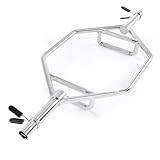
Overview: The VEVOR Trap Bar positions itself as a mid-range powerhouse with an impressive 800-pound capacity that exceeds many competitors. Constructed from heavy-duty steel with a chrome-plated finish, this 2-inch sleeve bar targets serious home gym enthusiasts and strength athletes. The ergonomic knurled grips and hexagonal frame design promote proper lifting mechanics across deadlifts, squats, presses, and carries.
What Makes It Stand Out: The exceptional 800-pound capacity challenges premium bars at a fraction of their cost, while the fine knurled texture provides superior grip security compared to smoother alternatives. Chrome plating offers excellent rust and scratch resistance for long-term durability. The bar’s compact storage design fits easily under furniture, solving space constraints for apartment dwellers.
Value for Money: At $129.99, this bar occupies a sweet spot between budget and premium options. The 800-pound capacity and chrome finish deliver specs typically found in $200+ bars, making it an excellent value for intermediate to advanced lifters. While lacking the open design of premium alternatives, the core functionality and durability rival much more expensive equipment.
Strengths and Weaknesses: Strengths include outstanding weight capacity, secure knurled grips, durable chrome finish, compact storage design, and versatile exercise applications. Weaknesses involve VEVOR’s lesser-known brand reputation compared to CAP, potential quality control inconsistencies, and the standard closed-frame design lacking innovative features like built-in jacks or open-ended versatility.
Bottom Line: For lifters seeking maximum capacity without maximum spending, the VEVOR trap bar delivers professional-grade specs at a mid-range price. It’s an intelligent upgrade for growing home gyms.
6. Hex Trap Bar 2-Inch Olympic Weightlifting Barbell,48.6" Deadlift Bar for Squats,Shrugs,Push-Ups,400Lbs Weight Capacit Suitable Home Gym Equipment Workouts for Beginners,Women,Men-Multiple Colors (BLACK)

Overview: This 48.6-inch hex bar offers an entry point into trap bar training at just $50.19. Weighing only 14.5 pounds with a 400-pound capacity, it features 10-inch loadable sleeves compatible with standard 2-inch Olympic plates. The black electrophoretic coating promises corrosion resistance, while the ergonomic hexagonal design aims to reduce lower back strain during deadlifts and shrugs.
What Makes It Stand Out: The beginner-friendly positioning is this bar’s main selling point. The manufacturer explicitly markets it toward novices, women, and anyone intimidated by straight barbell training. The raised handle design creates a 7-inch effective width and 3.4-inch height, providing natural lifting mechanics similar to picking up a heavy bag. The electrophoretic coating offers better durability than basic paint at this price point.
Value for Money: At under $51, this represents one of the most affordable hex bars available. Comparable budget options typically cost $60-80, making this an exceptional entry-level value. However, the 400-pound limit may require upgrading sooner than pricier alternatives, potentially offsetting initial savings for rapidly progressing lifters.
Strengths and Weaknesses: Pros: Extremely affordable; beginner-friendly design; quality coating; lightweight for easy storage; ergonomic handle spacing. Cons: Lower 400-pound capacity limits long-term growth; 14.5-pound bar weight feels less substantial; 10-inch sleeves restrict total plate loading; unknown brand reliability.
Bottom Line: Perfect for beginners testing hex bar training without financial commitment. The thoughtful ergonomic design and protective coating punch above its price class, but serious lifters will outgrow its capacity quickly. Ideal for home gyms focused on moderate strength training and functional fitness.
7. CAP Barbell Olympic Trap Bar, Hex Bar, Shrug Bar, Deadlift Bar, Red , 50"

Overview: CAP Barbell’s 50-inch trap bar brings brand recognition to the mid-range segment at $63.99. Weighing 28 pounds with a 500-pound suggested capacity, this tubular steel construction features 9.5-inch loadable sleeves and neutral-placed grips. The integrated feet protect floors and stabilize the bar during plate changes, while the vibrant red finish adds visual appeal to home gyms.
What Makes It Stand Out: CAP’s established reputation in home fitness equipment provides confidence in quality control and customer support. The protective feet are a standout feature rarely seen in budget options, preventing floor damage and eliminating the need to deadlift the bar for plate loading. The compact tubular steel design minimizes space requirements while maintaining structural integrity.
Value for Money: Priced in the mid-range, this bar offers good value for CAP brand loyalists. However, the critical limitation is plate compatibility—it’s designed exclusively for cast iron plates, explicitly prohibiting bumper plates. This restriction reduces versatility compared to similarly priced competitors, potentially requiring additional equipment investments.
Strengths and Weaknesses: Pros: Trusted brand name; protective floor feet; 500-pound capacity; stable 28-pound bar weight; space-efficient design. Cons: Incompatible with bumper plates; shorter 9.5-inch sleeves limit loading; no collars included; basic finish may chip over time.
Bottom Line: A reliable choice for home gym owners using cast iron plates exclusively. The floor protection and brand backing justify the price premium over no-name alternatives, but the plate compatibility limitation is a dealbreaker for anyone wanting bumper plate versatility. Best for traditional strength training setups.
8. PROIRON Olympic Trap Bar 2", Hex Deadlift Squat Bar, 56" Weight lifting Shrug Bars Barbell Knurled Handles for Shoulder Exercises, Farmers Walk, 250kg Capacity for Home Gym Workout

Overview: PROIRON’s 56-inch hex bar positions itself as a premium option at $104.39, boasting a 250kg (550-pound) capacity and heavy-duty construction. The 5mm thick steel frame features knurled handles for enhanced grip security during farmer’s walks and shrugs. With 30cm (11.8-inch) loadable sleeves, this bar accommodates substantial weight for serious strength progression.
What Makes It Stand Out: The knurled handles differentiate this bar from smoother competitors, providing critical grip security during heavy lifts and dynamic movements like farmer’s walks. The extra-long sleeves significantly outpace standard 10-inch designs, allowing advanced lifters to load more plates without compression issues. Included gap rings create customizable hand clearance, a thoughtful detail for user comfort.
Value for Money: While nearly double the price of budget options, the PROIRON delivers professional-grade features. The 550-pound capacity, knurled grips, and extended sleeves justify the cost for intermediate to advanced lifters. However, the absence of included collars requires an additional purchase, slightly diminishing the overall value proposition.
Strengths and Weaknesses: Pros: Excellent 550-pound capacity; superior knurled grip; extra-long sleeves; thick 5mm steel construction; gap rings included. Cons: No collars provided; highest price point; may be overbuilt for beginners; matte finish shows wear more visibly.
Bottom Line: Ideal for serious home gym enthusiasts ready to invest in long-term equipment. The knurled handles and extended sleeves support advanced training protocols that cheaper bars cannot accommodate. While beginners can certainly use it, the price and capacity make it best suited for committed lifters planning progressive overload beyond 400 pounds.
9. Zlinke Olympic Trap Bar, Hex Deadlift Squat Bar for 2" Olympic Barbell, 49" Shrug Bar with Handles, 500Lbs Weight Capacit Suitable Home Gym Equipment Workouts for Beginners,Women,Men

Overview: Zlinke’s 49-inch hex bar strikes a balance between affordability and performance at $59.99, offering a 500-pound capacity suitable for most home gym enthusiasts. The bar features 10-inch loadable sleeves compatible with all Olympic plate types, including bumpers, and includes two snap-in spring collars. The matte black finish provides basic corrosion resistance for indoor use.
What Makes It Stand Out: The back-friendly design is central to Zlinke’s marketing, emphasizing the hexagonal shape’s ability to maintain neutral spine positioning and keep weight closer to the body’s center of gravity. This makes it particularly appealing for beginners concerned about injury risk. The inclusion of spring collars adds immediate value, eliminating the need for separate purchases.
Value for Money: This bar competes directly with budget options while offering a higher 500-pound capacity. The included collars and universal plate compatibility make it a stronger value than the CAP bar at a similar price point. For lifters progressing beyond novice levels, this provides room to grow without immediate equipment replacement.
Strengths and Weaknesses: Pros: 500-pound capacity at budget price; includes spring collars; compatible with all Olympic plates; back-friendly design emphasis; good beginner marketing. Cons: Unknown brand longevity; basic finish quality; 10-inch sleeves adequate but not exceptional; limited customer review history.
Bottom Line: An excellent middle-ground option for home gym owners wanting more capacity than entry-level bars without premium pricing. The included collars and universal plate compatibility remove common friction points. While brand reputation remains unproven, the specifications and price make it a compelling choice for beginners to intermediate lifters focused on safe, progressive training.
10. SELEWARE Trap Bar Hex Bar for Deadlift, Olympic Hex Barbell Deadlift Trap Bar, 500 LBS Capacity Heavy Duty Weight Lifting Hex Bar Strength Training Equipment for Home Gym, Squats, Shrugs

Overview: SELEWARE’s hex bar emphasizes safety engineering at $79.19, featuring a 500-pound capacity with deliberate spacing between plates and handles to prevent hand injuries. The reinforced sleeve design uses three screws per side for enhanced durability, addressing a common failure point in budget bars. This patent-pending design targets home gym users prioritizing injury prevention during solo workouts.
What Makes It Stand Out: The safe gap design is the defining feature, ensuring hands remain protected during high-rep sets and explosive movements. The triple-screw sleeve reinforcement demonstrates attention to structural integrity that exceeds typical budget construction. The company’s US patent pending status suggests genuine innovation rather than generic rebranding.
Value for Money: Priced between mid-range and premium, this bar justifies its cost through safety-focused engineering. While more expensive than basic 500-pound capacity bars, the reinforced construction and protective design elements offer peace of mind that may prevent costly injuries. However, the brand lacks the established reputation of CAP or PROIRON.
Strengths and Weaknesses: Pros: Innovative safe gap design; reinforced triple-screw sleeves; 500-pound capacity; hand injury prevention focus; patent-pending engineering. Cons: Higher price for unknown brand; no collars mentioned; limited user reviews; marketing may overstate uniqueness.
Bottom Line: Best suited for safety-conscious lifters, particularly those training alone without spotters. The protective gap design and reinforced sleeves address legitimate concerns about budget bar longevity and user safety. While the premium over generic 500-pound bars is notable, the engineering focus on injury prevention makes it worthwhile for risk-averse home gym owners who prioritize long-term durability and safe training mechanics.
Why the Trap Bar is a Deadlift Game-Changer
The trap bar’s genius lies in its ability to solve problems that have plagued lifters for decades. By stepping inside the bar rather than standing behind it, you align the load with your body’s natural center of mass. This simple geometric shift reduces the moment arm between the weight and your lumbar spine, typically decreasing shear forces by 10-15% compared to conventional deadlifts. What does this mean in practice? You can train heavy, frequently, and with less cumulative spinal stress while actually increasing total force production.
Research consistently shows that lifters can pull more absolute weight with a trap bar—often 5-10% more than their conventional max. This isn’t because it makes the movement “easier” in a pejorative sense; it’s because the biomechanics allow for greater peak force and power output. Your quads engage more aggressively, your grip position becomes anatomically neutral, and the movement pattern becomes a beautiful hybrid between a squat and a hinge. For athletes, this translates to sport-specific power development. For general population lifters, it means building impressive strength without the orthopedic price tag.
Understanding Trap Bar Anatomy: What Makes It Different?
Before diving into features, you need to understand the fundamental architecture that distinguishes trap bars from their straight counterparts. The hexagonal or diamond-shaped frame creates a cavity where the lifter stands, with weight sleeves extending from either end of the structure. This design isn’t arbitrary—it’s a carefully engineered solution to optimize human movement under load.
The handles, positioned at 90 degrees to the sleeves, allow for a neutral grip that eliminates the supination/pronation demands of a straight bar. This grip orientation doesn’t just feel more comfortable; it reduces bicep strain during heavy pulls and allows for a more natural shoulder position. The distance between the handles, the height of the grips relative to the floor, and the width of the frame all play crucial roles in determining how the bar will interact with your unique anthropometry. Understanding these variables transforms you from a passive consumer into an informed decision-maker.
The Biomechanical Advantage: Easier on Your Back, Harder on Your Muscles
The trap bar’s reputation as a “back-saver” is well-deserved, but that label undersells its true capabilities. When you step inside the hex frame, the load aligns vertically with your mid-foot, placing you in a more upright starting position. This posture reduces the hip hinge demand and subsequent lumbar flexion moment that makes conventional deadlifts so technically demanding. Your erector spinae still work intensely—they’re just not fighting the same leverage battle.
Meanwhile, your quadriceps receive a stimulus that conventional deadlifts simply cannot replicate. The more upright torso position increases knee extensor demands, creating a movement that’s approximately 60% hinge and 40% squat. This hybrid nature makes the trap bar deadlift a phenomenal tool for athletes who need to develop both posterior chain power and anterior chain strength simultaneously. Studies using electromyography show significantly greater vastus lateralis activation in trap bar deadlifts compared to conventional pulls, while glute and hamstring activation remains comparably high. You’re not sacrificing posterior chain development—you’re just distributing the workload more intelligently.
Key Features to Evaluate Before Buying
Sleeve Length and Load Capacity
The sleeves determine how much weight you can load and how the bar feels with heavy plates. Standard Olympic sleeves measure 16 inches, but trap bar designs vary dramatically. Shorter sleeves might limit you to 400-500 pounds total, which could be a ceiling for stronger lifters. Longer sleeves accommodate more plates but may affect the bar’s balance and require more gym space.
Pay attention to sleeve diameter—50mm is the Olympic standard, ensuring compatibility with calibrated plates and collars. The sleeve’s construction matters too: is it a single piece welded to the frame, or a bolt-on component? One-piece designs typically offer better durability and less play under load. Consider the loadable length carefully; if you’re pulling in the 600+ pound range, you’ll need at least 15 inches of sleeve space to fit enough plates without resorting to thin competition plates.
Handle Design and Grip Variations
Handle design dramatically impacts both comfort and performance. Most quality trap bars offer dual-handle options: a “low” handle that’s level with the bar’s centerline, and a “high” handle raised 3-4 inches above it. This isn’t just a convenience feature—it’s a programming tool. The high handle reduces range of motion, perfect for overload training or lifters with mobility restrictions. The low handle provides a deficit deadlift effect, increasing range of motion and mechanical tension.
Grip diameter typically ranges from 28mm to 32mm. Thinner handles challenge grip strength but may dig into your palms during maximal loads. Thicker handles distribute pressure better and build crushing grip strength as a secondary benefit. Some bars feature rotating handles that spin like an Olympic barbell’s sleeves, reducing torque on your joints during explosive reps. Fixed handles offer more stability but can feel harsh during high-volume training. The handle spacing—distance between left and right grips—should match your shoulder width. Too narrow and you’ll feel cramped; too wide and you’ll lose lat engagement.
Bar Weight and Balance
Trap bars typically weigh between 45 and 75 pounds, significantly heavier than the standard 45-pound straight bar. This matters for loading calculations and progressive overload programming. A 60-pound bar means you’re pulling 15 pounds more than you might think, which can either be a pleasant surprise or a programming headache depending on your tracking system.
Balance is equally crucial. A well-designed trap bar’s center of gravity sits directly over your mid-foot when loaded. Poorly balanced bars feel “tippy,” especially during farmer’s walks or dynamic movements. The weight distribution between the front and back of the frame should be symmetrical. Some manufacturers add counterweights to achieve perfect balance, while others engineer it into the frame geometry. Test this if possible: load the bar with moderate weight and see if it rocks forward or backward when set down on level ground.
Frame Geometry and Clearance
The frame’s shape determines how much space you have for your legs, hips, and torso during the lift. A hexagonal design offers more internal room than a diamond shape, which can be beneficial for larger athletes or those with broader shoulders. The distance from the handle to the back of the frame affects how far the plates sit behind you—too close and you might hit your calves at lockout; too far and the bar becomes unwieldy.
Vertical clearance is another critical factor. The distance from the floor to the bottom of the loaded plates must accommodate your shin height. Some compact trap bars position plates lower, which can cause scraping on the ascent. Premium designs elevate the plates slightly, creating a “floating” effect that prevents contact with your shins while maintaining proper starting height. The frame’s width should allow you to stand with your feet hip-width apart without your knees brushing the interior edges during the lift.
Open vs. Closed Design: Which Philosophy Matches Your Training?
The traditional closed hex bar completely surrounds you, creating a stable but confined lifting environment. This design excels for pure deadlift training and offers maximum structural integrity. However, it limits your options for exercises that require stepping in and out quickly, like circuit-based farmer’s walks or loaded carries.
Open trap bars—shaped like a squared “U” or “C”—have gained immense popularity for their versatility. You can walk into the bar from the open side, making it easier to set up for lunges, split squats, and even overhead presses. This design shines for functional training and strongman-style carries. The trade-off is typically reduced maximum load capacity and potentially less rigidity under extreme weight. The open side can flex slightly when loaded to 600+ pounds, though this is rarely noticeable during actual lifting. Consider your primary use case: if you’re buying specifically for heavy deadlift training, closed designs often feel more bombproof. If you want a multi-tool for varied programming, open designs offer creative freedom.
The Handle Height Debate: Standard, Elevated, and Adjustable Options
Handle height fundamentally alters the movement’s biomechanics and difficulty. Standard handles position your hands at roughly the same height as a conventional deadlift, creating a challenging range of motion that builds strength off the floor. Elevated handles—typically 3-4 inches higher—reduce the hip hinge demand and allow you to lift heavier loads, making them ideal for athletes with limited hamstring mobility or those focusing on lockout strength.
Adjustable handle systems represent the premium tier, offering multiple height settings from 2-6 inches above the bar’s centerline. This versatility comes at a price, both financially and in terms of complexity. More moving parts mean more potential failure points, and the adjustment mechanisms add weight. However, for coaches training diverse populations or lifters who want to periodize handle height throughout training blocks, adjustability is invaluable. Consider your anthropometry: taller lifters with long arms might find standard handles force them into excessive knee flexion, while shorter lifters might struggle to reach elevated handles without standing on plates.
Material Matters: Steel Grades, Coatings, and Durability
The steel grade determines a trap bar’s tensile strength, whip, and long-term durability. Most commercial-grade bars use alloy steel with tensile strengths between 130,000 and 150,000 PSI. This range provides excellent stiffness without becoming brittle. Higher-end options might utilize proprietary steel blends claiming 190,000+ PSI tensile strength, which offer supreme rigidity for elite-level loads but come with premium pricing.
Coatings serve both protective and performance functions. Black oxide provides a raw, grippy feel but offers minimal rust resistance—fine for climate-controlled home gyms but problematic in humid commercial spaces. Chrome and zinc plating create durable barriers against corrosion but can feel slick when hands get sweaty. Cerakote and other ceramic-based coatings represent the modern standard, offering vibrant colors, exceptional corrosion resistance, and a consistent grip feel. Powder coating, while durable for frames, often feels too slick for handles and can chip over time. The interior of the bar—where you stand—should have a coating or treatment that prevents rust from sweat accumulation.
Knurling Patterns: Finding Your Perfect Grip Texture
Knurling on trap bar handles serves the same purpose as on straight bars: creating friction between your palm and the steel. However, the neutral grip orientation changes how your hands interact with the pattern. Aggressive mountain-style knurling, with its sharp, deep cuts, provides maximum grip security for heavy singles but can tear up your hands during high-volume sessions. Passive hill-style knurling feels smoother and more comfortable for sets of 5-10 reps but might slip when pulling near-maximal loads.
The knurling’s coverage area matters significantly. Some bars feature knurling that extends across the entire handle width, allowing you to adjust hand position. Others use precise patches positioned exactly where your hands should sit, which can enforce proper technique but limit customization. Center knurling is typically absent on trap bars since the handles are separate, but some designs include textured sections on the frame itself for exercises where you might grip the bar differently. The depth and pattern consistency should be uniform across both handles—any asymmetry will feel immediately noticeable under load.
Budget Considerations: Investment vs. Long-Term Value
Trap bar pricing spans from $150 budget options to $800+ premium models, and understanding what you’re paying for helps avoid both overspending and underspending. Entry-level bars in the $150-$250 range typically use lower-grade steel, bolt-on sleeves, and basic coatings. They’ll handle loads up to 400-500 pounds reliably but may develop sleeve play, coating chips, or slight frame flex over time. For beginners or home gym owners pulling sub-400 pounds, these represent excellent value.
Mid-tier options ($250-$450) offer the sweet spot for most serious lifters. You’ll find one-piece construction, better steel grades, dual-handle designs, and durable coatings. These bars typically carry warranties of 3-5 years and can handle 600-800 pound loads without complaint. The finish quality improves dramatically, with consistent knurling and thoughtful design details like raised plate flanges.
Premium trap bars ($450+) deliver features that matter for specific populations: adjustable handles, open designs for versatility, proprietary steel alloys, and craftsmanship that approaches art. These bars often come with lifetime warranties and can withstand commercial gym abuse. The question isn’t whether they’re better—it’s whether you’ll utilize the features enough to justify the cost. For most lifters, a $300-$400 bar offers 90% of the performance at half the price. Think of it as buying a car: the Honda Accord gets you to work just as reliably as the BMW, but the driving experience differs.
Space and Storage: Real-World Practicality
A trap bar’s footprint extends far beyond its actual dimensions when you account for loading plates and the space needed to maneuver around it. Closed hex bars typically measure 56-60 inches in length, requiring as much storage space as a standard barbell but with more width. Open designs can be slightly longer but offer more storage flexibility since you can lean them vertically against a wall.
Consider your gym’s layout: will you need to carry the bar to different areas for farmer’s walks? A 70-pound bar becomes awkward to maneuver through tight spaces. Do you have a vertical barbell storage rack? Most trap bars won’t fit in standard horizontal wall mounts and require dedicated floor space or a custom solution. Some modern racks include trap bar storage pegs, which is worth considering if you’re planning a comprehensive home gym build.
The bar’s width affects how you load plates. If your gym has narrow walkways between equipment, a 28-inch wide frame might block traffic when loaded. Measure your space: you need at least 8 feet of clear width to load and lift comfortably, plus additional room for plate storage nearby. Remember, you can’t just rack a trap bar like a straight barbell—it lives on the floor when not in use.
The Learning Curve: Technique Adjustments for Trap Bar Newcomers
Transitioning from conventional deadlifts to trap bar pulls isn’t as simple as stepping inside and yanking. The altered center of mass changes your entire movement pattern. First, your starting position will feel more upright—resist the urge to artificially hinge forward to mimic your conventional pull. Instead, embrace the quad engagement and think about “squatting” the weight up rather than pulling it back.
Foot placement requires experimentation. Most lifters find success with a hip-width stance, but the trap bar allows for wider positioning without the grip limitations of a straight bar. Your shins should be vertical or slightly inclined, with the handles positioned directly over your mid-foot. The neutral grip eliminates the need to “screw” your arms into your torso, but you should still engage your lats by thinking about “breaking the handles” apart before the pull.
The lockout changes dramatically. Without a barbell against your thighs, you’ll need to develop a new sense of completion. Focus on driving your hips forward until your knees and hips are fully extended, squeezing your glutes forcefully. Many newcomers under-lock trap bar deadlifts, leaving potential power on the table. Film yourself from the side to ensure you’re reaching full hip extension, not just getting the weight high enough to drop it.
Programming Your Trap Bar: Sets, Reps, and Periodization Strategies
The trap bar’s versatility demands thoughtful programming to maximize its benefits. For pure strength development, treat it like your primary deadlift variation: work in the 3-6 rep range with 80-90% of your estimated max. Because you can typically pull more weight, recalibrate your percentages—a 600-pound conventional deadlifter might find their trap bar 1RM around 650 pounds, so 85% training loads adjust accordingly.
For hypertrophy, the trap bar shines in the 6-12 rep range. The neutral grip and reduced spinal stress allow for higher volume without the same neural fatigue as conventional deadlifts. Try sets of 8-10 with controlled eccentrics to maximize time under tension. The trap bar also excels for cluster sets: perform 5 reps, rest 20 seconds, then another 5 reps, allowing you to accumulate 10 quality reps at a higher intensity than straight sets would permit.
Power development benefits from the trap bar’s explosive potential. Use the high handles for speed work: 6-8 sets of 3 reps at 50-60% of your max, focusing on maximal velocity off the floor. The trap bar’s design allows for greater peak power output than conventional deadlifts, making it ideal for athletes training rate of force development. Consider alternating three-week blocks: a strength-focused block with low handles and heavy loads, followed by a power block with high handles and explosive intent.
Common Mistakes That Sabotage Your Progress
Even with its forgiving design, the trap bar reveals common technical errors that limit progress. The most frequent mistake is treating it like a conventional deadlift—excessive hip hinge with vertical shins. This position places the handles behind your center of mass, forcing you to pull the weight forward on the ascent and placing unnecessary stress on your lower back. Instead, allow your knees to travel forward over your toes in the start position, creating a more quadriceps-dominant posture.
Grip errors plague trap bar training. The neutral grip can encourage a relaxed upper back, with shoulders protracting and lats disengaging. Combat this by actively “spreading” the handles apart throughout the lift, creating tension through your upper back. Another subtle mistake is gripping too high on the handles, which increases the effective range of motion unnecessarily. Your hands should sit in the center of the handles, with the bar’s weight distributed across your palm, not pinching your fingers.
Loading errors can be dangerous. Because trap bars sit on the floor differently than straight bars, plates can sit slightly off-center if you’re not careful. Always load plates symmetrically, and spin the loaded bar before lifting to ensure it doesn’t wobble. Some lifters make the mistake of using collars that are too tight, which can damage sleeve coatings over time. Use quality Olympic collars that distribute pressure evenly.
Beyond Deadlifts: Unconventional Uses for Your Trap Bar
The trap bar’s utility extends far beyond deadlift variations, transforming it into one of the most versatile tools in your gym. Farmer’s walks become exponentially more comfortable and stable with a trap bar—the weight sits beside you rather than behind, allowing for a more natural gait and heavier loads. The neutral grip reduces bicep strain during long carries, and the frame’s width prevents plates from clipping your legs.
Floor presses with a trap bar offer a unique pressing variation that challenges stability and reduces shoulder strain compared to barbell presses. Lie on the floor inside the bar, grip the handles, and press as you would with dumbbells. The bar’s weight distribution creates a different stability challenge, engaging your core and scapular retractors differently than traditional pressing. You can even perform overhead presses by cleaning the bar from the floor and pressing from the standing position—though this requires an open-design bar and careful attention to balance.
Lunges and split squats become brutally effective with a trap bar. Step into the bar, lift it to standing, then perform walking lunges. The weight’s position relative to your center of mass creates a more upright torso, reducing lower back stress while crushing your quads. Some innovative coaches use trap bars for bent-over rows, shrugs, and even as a makeshift cambered bar for squats by holding it in the crooks of your elbows. The only limit is your creativity—and the bar’s design limitations.
Maintenance and Care: Protecting Your Investment
A quality trap bar should last decades, but only with proper maintenance. Sweat is your bar’s primary enemy. The interior cavity where you stand collects moisture, salt, and chalk, creating a perfect environment for rust. After each session, wipe down the handles and interior frame with a dry cloth. Weekly, use a nylon brush to clear knurling of debris, then apply a light coat of 3-in-1 oil to bare steel areas.
Inspect welds monthly, especially if you’re dropping the bar from height or using it for dynamic movements. Look for hairline cracks or rust forming at weld points—these are stress indicators that precede failure. Tighten any bolts (if your bar has them) every few months, as vibration from drops can loosen connections. For bars with rotating sleeves, apply a drop of light machine oil to the bushing or bearing interface quarterly to maintain smooth rotation.
Storage environment matters immensely. If your gym experiences humidity fluctuations, consider a dehumidifier or store the bar with silica gel packets inside the frame cavity. Never store a trap bar loaded with plates for extended periods—this can cause sleeve sag and frame distortion over time. If you notice coating chips, touch them up immediately with nail polish or automotive touch-up paint to prevent rust spread. A well-maintained trap bar doesn’t just look better; it performs more safely and retains its value should you ever decide to upgrade.
Frequently Asked Questions
1. Will using a trap bar make my conventional deadlift weaker?
No—when programmed correctly, trap bar deadlifts complement and enhance your conventional pull. The increased quad strength and reduced spinal fatigue allow you to accumulate more productive training volume, which transfers to greater conventional deadlift strength over time.
2. How much more weight should I be able to trap bar deadlift compared to conventional?
Most lifters pull 5-10% more on trap bar deadlifts due to the improved leverage and reduced range of motion with high handles. However, using low handles can make the movement more challenging than conventional pulls for some body types.
3. Are trap bar deadlifts safer than conventional deadlifts?
They place significantly less shear stress on the lumbar spine, making them inherently safer for the lower back. However, any loaded movement carries risk—proper technique remains essential to protect your knees, shoulders, and overall structural integrity.
4. Can I compete in powerlifting using a trap bar?
No, powerlifting competitions require a straight barbell for the deadlift. However, many competitive powerlifters use trap bars as a primary assistance movement to build strength while managing fatigue.
5. What’s the difference between a trap bar and a hex bar?
The terms are interchangeable. “Trap bar” is the original name coined by the inventor, Al Gerard, while “hex bar” describes the six-sided shape. Both refer to the same piece of equipment.
6. Should beginners start with trap bar deadlifts before conventional?
Absolutely. The trap bar teaches proper bracing, hip drive, and full-body tension with a more forgiving learning curve. Mastering the trap bar first builds the foundation and confidence needed for conventional deadlift success.
7. How do I know if a trap bar will fit my body type?
Measure your shoulder width and compare it to the bar’s handle spacing (typically 23-25 inches). If you’re exceptionally tall (over 6'4") or broad, look for bars with wider frames and longer sleeves to ensure adequate clearance.
8. Can I do Romanian deadlifts with a trap bar?
Yes, though the technique differs. Stand on blocks to increase range of motion, and focus on pushing your hips back while maintaining a neutral spine. The trap bar’s design actually encourages better form by preventing the bar from drifting away from your body.
9. Why do some trap bars have rotating handles?
Rotating handles reduce torque on your wrists and elbows during explosive reps, similar to how barbell sleeves spin during Olympic lifts. This feature benefits athletes doing speed work or high-volume training but adds cost and maintenance requirements.
10. Is an open trap bar worth the extra cost over a closed design?
If you value exercise variety and plan to use the bar for lunges, carries, and creative movements, the open design justifies its price premium. For pure deadlift specialization, a well-built closed trap bar offers better value and often higher load capacity.